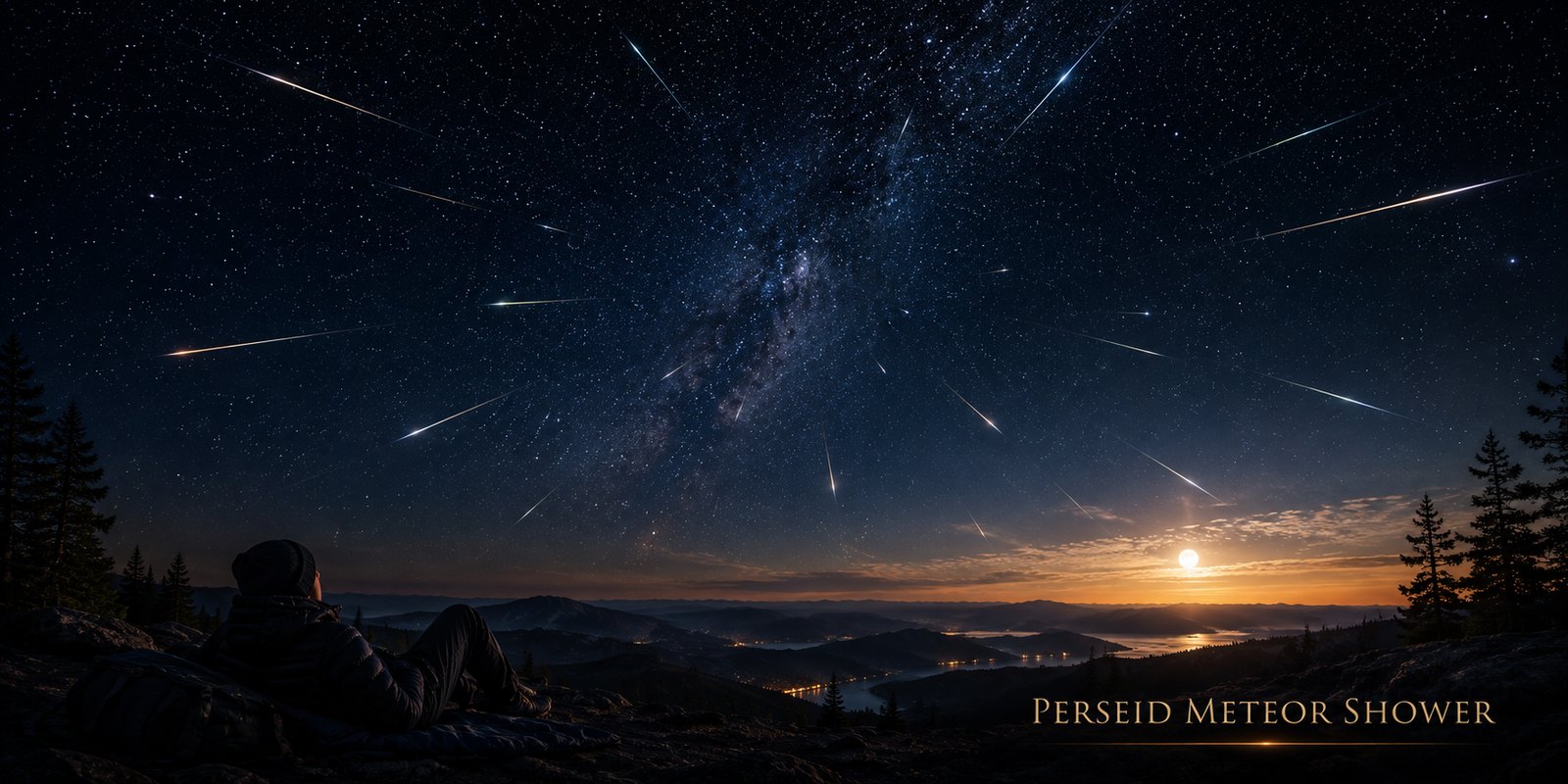
The Perseid meteor shower returns August 12–14, 2027
The year's most reliable big meteor shower peaks around August 13, 2027, with the best hours before dawn on the 13th and 14th. Honest conditions report: 2027 is a bright-Moon year, and a waxing gibbous washes out the faint meteors most of the night. But the Moon sets before dawn, opening a dark window in exactly the hours when Perseid rates are highest anyway. Plan for pre-dawn, and it's still a genuine show: up to 50–100 meteors an hour under dark skies, no telescope needed.
1The Perseids: the one to actually go outside for
The Perseids are the debris trail of comet 109P/Swift–Tuttle: every August, Earth plows through the dust it has shed, and those specks hit the atmosphere at ~59 km/s (37 miles a second) and burn up as shooting stars. The comet swings around the Sun every 133 years, and Earth crosses its debris every year from July 17 to August 24, with the peak in mid-August. The particles burn up about 60 miles (100 km) up, and the Perseids are famous for bright fireballs that leave glowing trains hanging in the sky.
About that Moon. A waxing gibbous rides high through most of the night on the 2027 peak dates, and moonlight is the great meteor killer. But a gibbous Moon sets in the early-morning hours, so the classic Perseid advice doubles in importance this year: the pre-dawn window isn't just the best time, it's effectively the only dark time. Two focused hours before morning twilight beats a whole evening under moonlight.
2How to watch (it's genuinely easy)
- When: the last two hours before morning twilight on August 13 and 14, after the Moon sets and while the radiant in Perseus rides high in the northeast.
- Where: get away from city lights. A dark location with an open horizon makes an enormous difference. And while the Moon is still up, keep it at your back.
- How: no telescope, no binoculars. They narrow your view. Lie back, take in as much sky as you can, and give your eyes 20–30 minutes to fully dark-adapt (a phone screen resets it).
- Look: generally toward Perseus in the northeast, but meteors streak anywhere in the sky, so a wide view beats staring at one spot.
3Filming it on your iPhone: settings cheat sheet
Phone video of a meteor shower is a real thing now, with expectations set honestly: at normal speed a recent iPhone will catch the brighter meteors and fireballs, not the faint streaks your eyes see. The Perseids throw plenty of bright ones, so it's worth running. The setup that works:
| Setting | Value |
|---|---|
| Mode | Video |
| Resolution / frame rate | 4K at 24 fps |
| Lens | 1× main camera · exactly 1.0×, no digital zoom |
| Orientation | Landscape |
| Tripod | Yes · completely stationary |
| Action Mode / Cinematic / Flash | All off |
| HDR / Dolby Vision | Off · you want predictability and easier recovery of a very dark image |
- Focus: point at a bright star or a distant light, then touch and hold until AE/AF LOCK appears. You do not want autofocus hunting mid-recording.
- Exposure: start at 0 EV; only lower toward −0.3 EV if the sky looks visibly gray or orange from light pollution. After locking, drag the sun icon just enough to keep the sky naturally dark.
- Recording: run 20–30 minute continuous clips, then restart. Longer is fine if you have the storage and power.
- Battery: plug into a power bank. Continuous 4K in night air drains fast.
- Screen: after framing, turn brightness way down. Your night vision is the instrument that actually sees the show.
4How 2026 went: the new-Moon year with a bonus eclipse
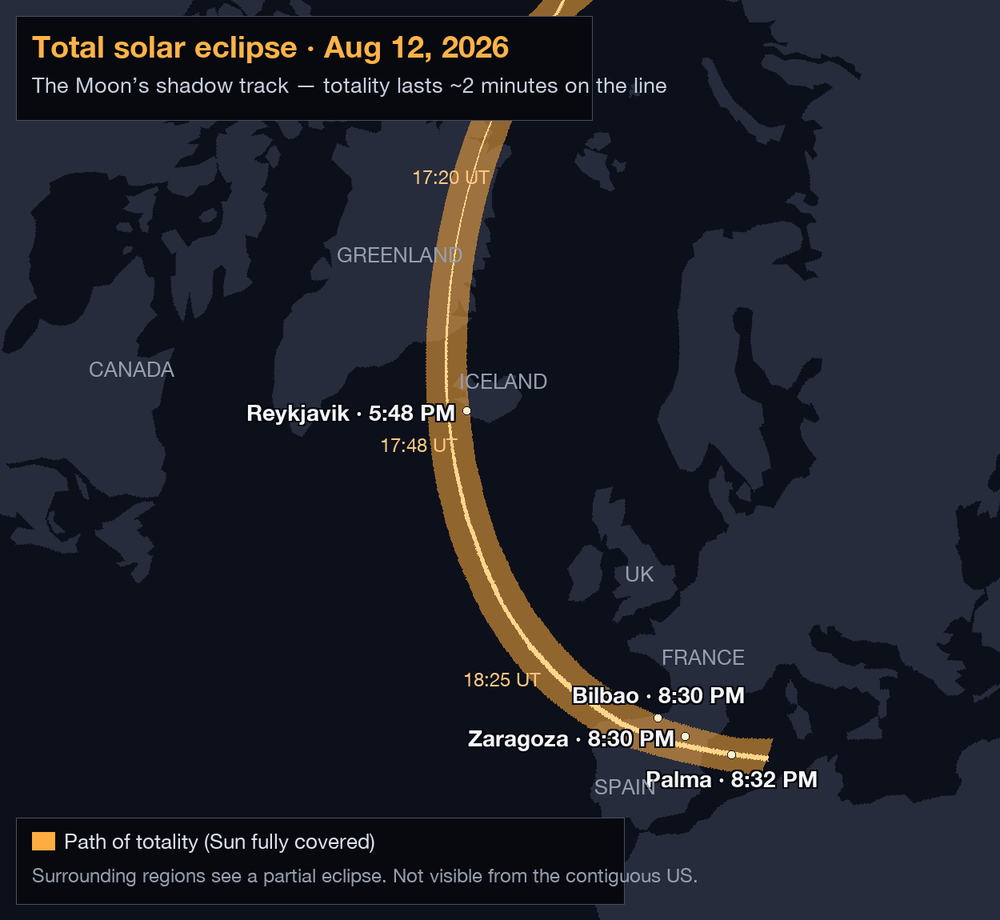
2026 was the setup 2027 isn't: the new Moon landed exactly on the peak, giving the darkest Perseid skies in years. NASA called the viewing "ideal." And it wasn't just dark by luck: that same new Moon slid in front of the Sun on August 12, throwing a total solar eclipse across Greenland, Iceland and northern Spain: the first Icelandic totality since 1954, the first in mainland Spain since 1905. One new Moon, two of the year's best sky events.
Get the heads-up for the next one
We mostly send alerts about solar storms and the aurora. But when the sky's got something worth clearing your calendar for, subscribers hear about it. No spam, unsubscribe anytime. (Privacy: we store your address and nothing else.)
5Sources
- 2027 peak timing (maximum around Aug 13, best pre-dawn Aug 13–14; activity Jul 17–Aug 24) per the standard IMO/AMS meteor calendars and In-The-Sky.org's 2027 forecast.
- 2027 Moon conditions computed from the lunar cycle (new Moon ~Aug 1–2, 2027 → a ~85%-lit waxing gibbous on the peak nights, setting in the early-morning hours).
- Rates (up to 50–100/hr under dark skies) and comet 109P/Swift–Tuttle orbital details: NASA's Perseids material.
- 2026 eclipse recap: totality over Greenland, Iceland and northern Spain on Aug 12, 2026, from NASA/Espenak's eclipse elements.