The August 27–28, 2026 lunar eclipse: 96% of the Moon in Earth's shadow
This eclipse has passed. The page stays as a record of what was visible and when. The Americas' next deep lunar eclipse is June 26, 2029; the next big solar eclipse is August 2, 2027.
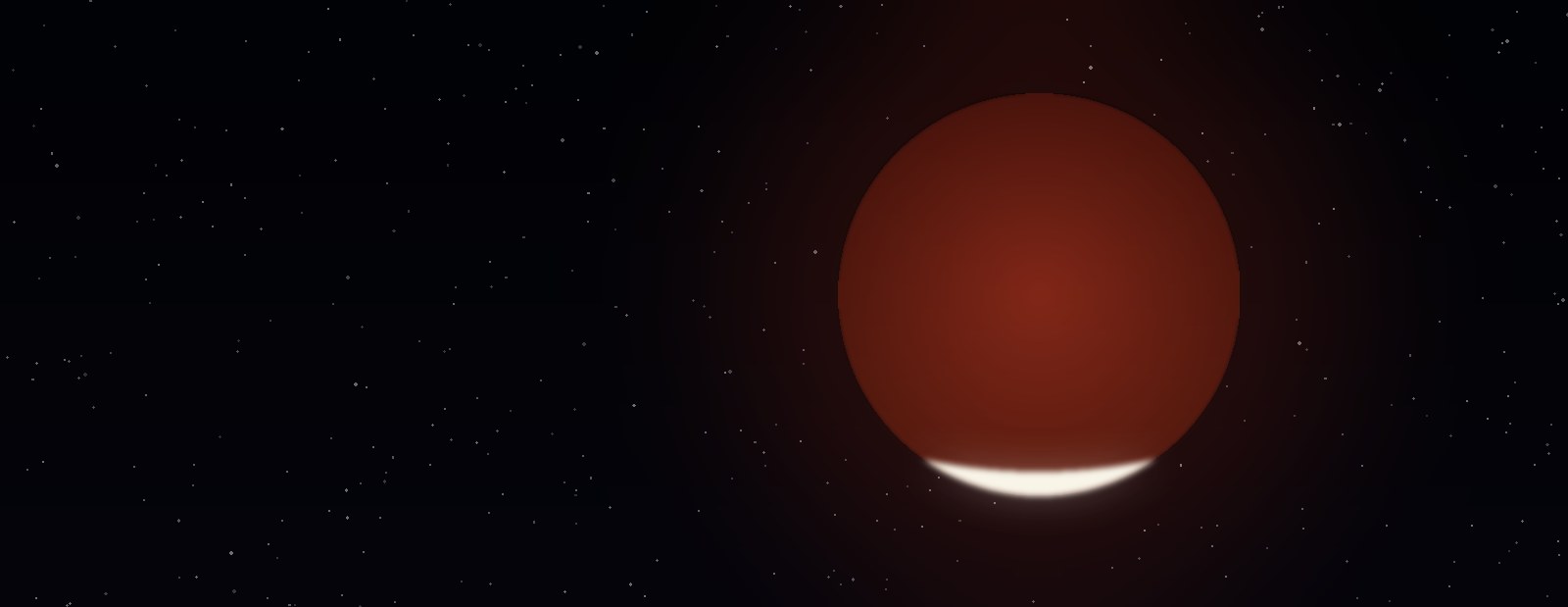
On the night of Thursday, August 27 (into the early hours of the 28th on the East Coast), Earth's shadow slides across the full Moon and swallows 96% of it. It's officially a partial eclipse, but only just. At maximum, the Moon should glow the dusky red of a total eclipse with one brilliant sliver left along its southern edge. The entire Americas get a view, it's completely safe to watch with the naked eye, and it's the last lunar eclipse this deep for viewers here until 2029.
1What's happening
August's full Moon, the Sturgeon Moon, passes through the northern part of Earth's umbra, the dark central core of our planet's shadow. The Moon's track misses the shadow's center by just enough that its southern limb never fully enters the umbra: coverage tops out at about 96% of the disk (umbral magnitude 0.93). Close enough to a total eclipse that the difference is one thin arc of daylight.
The shadowed part of the Moon doesn't go black. Sunlight bends through Earth's atmosphere and is filtered red on the way. The eclipsed Moon is lit by every sunrise and sunset on Earth at once. That's the "blood moon" color, and with 96% of the disk in shadow, this eclipse should show it well.
It's also a finale. This eclipse closes a remarkable run of four deep lunar eclipses in a year and a half (total eclipses in March 2025, September 2025 and March 2026, then this one). The next lunar eclipse, in February 2027, is penumbral, a shading so subtle most people can't see it. For the Americas, the next eclipse this dramatic is the total lunar eclipse of June 2029.
2Exact times
The whole event is generous: over three hours of visible shadow. The times that matter:
| Phase | UT (Aug 28) | Pacific | Mountain | Central | Eastern |
|---|---|---|---|---|---|
| Shadow first visible (partial begins) | 02:33 | 7:33 PM | 8:33 PM | 9:33 PM | 10:33 PM |
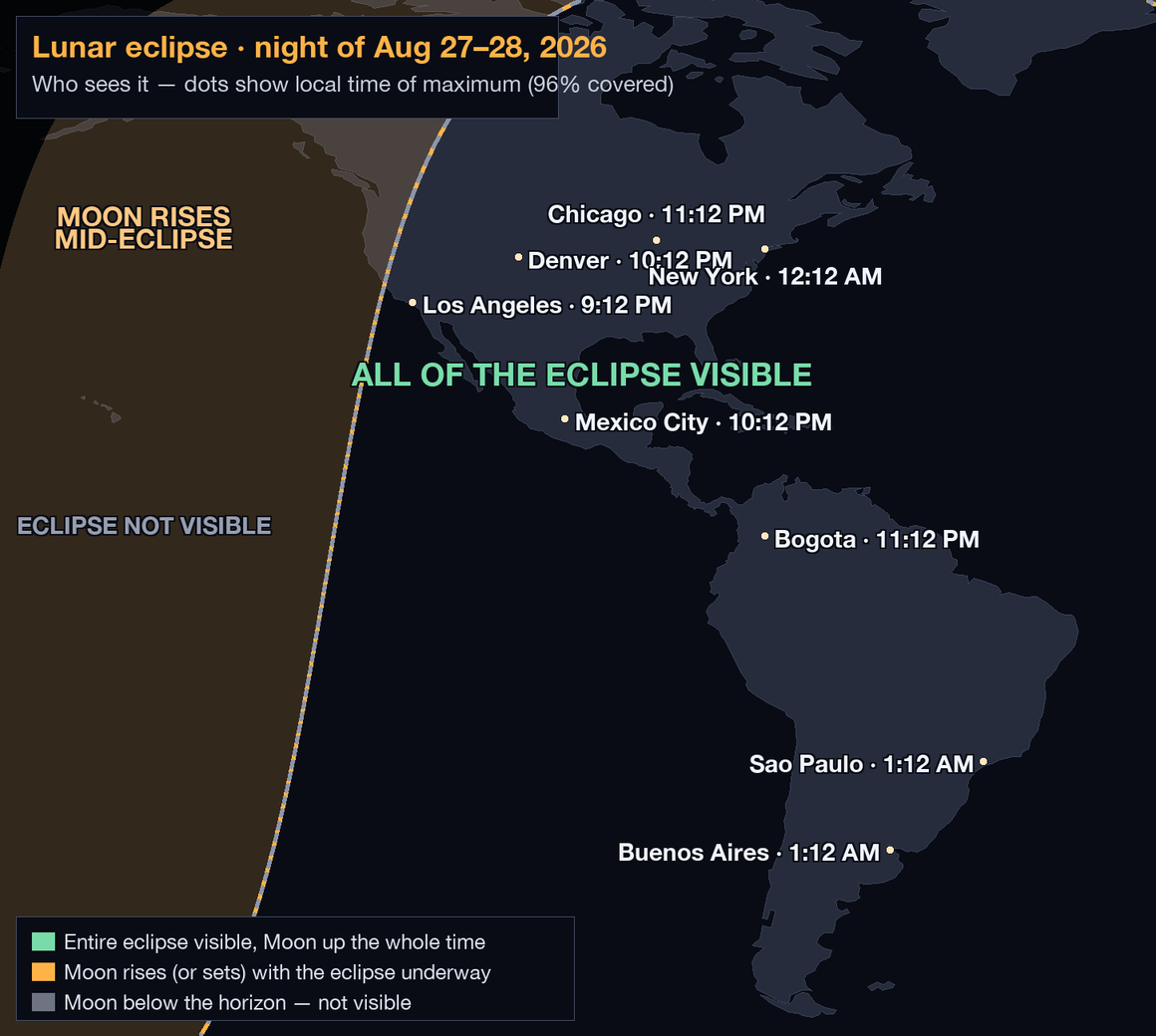
| Maximum · 96% covered | 04:12 | 9:12 PM | 10:12 PM | 11:12 PM | 12:12 AM |
| Shadow leaves the Moon (partial ends) | 05:52 | 10:52 PM | 11:52 PM | 12:52 AM | 1:52 AM |
All US times are the evening of Thursday, August 27, rolling past midnight into the 28th for the Central and Eastern zones. A faint penumbral shading starts about an hour before the partial phase and lingers an hour after, but the times above are what you'll actually notice.
3How to watch
- No equipment, no glasses. Unlike a solar eclipse, a lunar eclipse is just the Moon, completely safe to stare at. Binoculars are a bonus: they sharpen the curved edge of Earth's shadow and bring out the red.
- City skies are fine. This is the rare sky event where light pollution barely matters. The Moon outshines everything even in eclipse. Watch it from a sidewalk.
- Where to look: the full Moon rises in the east around sunset and climbs through the southeastern sky over the evening. If you can see the Moon, you're set.
- West Coast: the Moon rises around sunset with the eclipse already underway. Watch it come up over the eastern horizon with a bite taken out, then deepen to maximum at a very civilized 9:12 PM.
- East Coast: the entire eclipse happens with the Moon well up; maximum lands at 12:12 AM, just past midnight.
- What to expect at max: a coppery-red Moon with one dazzling white sliver on its lower (southern) edge, an eclipse that looks total everywhere except that arc.
4Get the heads-up
We mostly send alerts about solar storms and the aurora. But when the sky has something worth stepping outside for, subscribers hear about it. No spam, unsubscribe anytime. (Privacy: we store your address and nothing else.)
5Sources
- Contact times and geometry (umbral magnitude 0.932, gamma −0.469, partial phase 02:33–05:52 UT, maximum 04:12 UT Aug 28) from the standard NASA/Espenak eclipse elements, cross-checked against timeanddate.com and independent eclipse references.
- "96% of the disk" is the umbral coverage of the Moon's visible area at maximum; the southern limb remains outside the umbra (gamma is negative: the Moon passes north of the shadow axis).
- The "next deep eclipse in June 2029" claim is derived from the lunar eclipse catalog: February 2027 and the 2027–2028 events visible from the Americas are penumbral or shallow partials; the next total lunar eclipse visible from the Americas is June 26, 2029.
- Saros series 138, member 30 of 83.