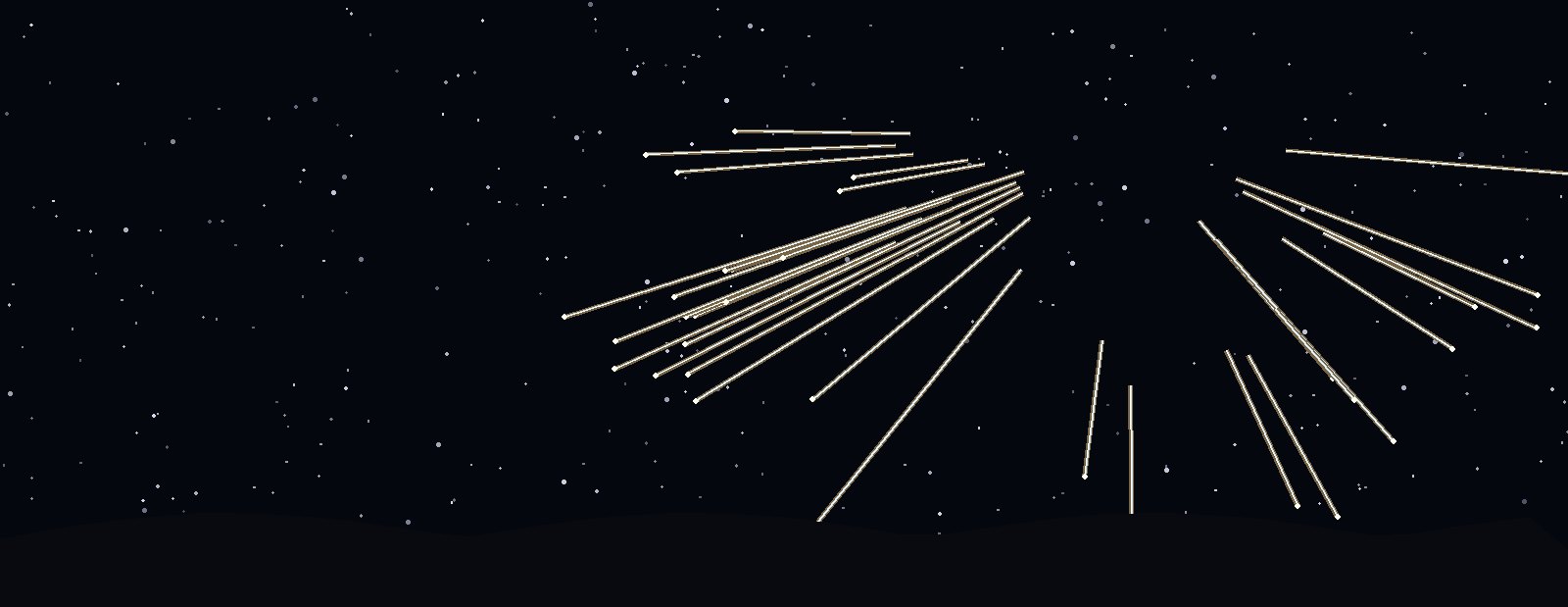
The Leonid meteor shower peaks November 17–18, 2026
Most years the Leonids are a connoisseur's shower: about 15 meteors an hour, but the fastest of any shower: 71 km/s dust that makes brilliant streaks and lingering trains. The reason they're famous is history: this is the stream that produced the great meteor storms, nights when the sky genuinely appeared to fall. 2026 is a normal year with decent conditions: a bright Moon early, then dark post-midnight hours as the radiant climbs.
1The shower that made the sky fall
On the night of November 12–13, 1833, people across North America woke to what many believed was the end of the world: meteors falling, in contemporary accounts, like snow. Modern estimates run to tens of thousands per hour. The event shocked science into taking meteors seriously as an astronomical phenomenon, and helped establish that showers have radiants and orbits. In 1966 it happened again: observers in the American Southwest saw thousands of meteors per minute during a brief, unforgettable burst. The 1999–2002 returns brought storms of thousands per hour.
The engine is comet 55P/Tempel–Tuttle, which returns every ~33 years and lays down a fresh, dense debris ribbon. When Earth crosses a young ribbon, the shower becomes a storm. Nothing of the kind is predicted for 2026. The comet's next return is 2031, and the following years are when forecasters will start watching the trails again.
2How to watch in 2026
- When: after midnight into the pre-dawn of November 18. The radiant in Leo rises late, so evening watching is largely wasted on this shower.
- The Moon: a ~65%-lit waxing gibbous brightens the evening but sets after midnight, right as the radiant climbs. The timing works in your favor: moonset and the shower's best hours coincide.
- What you'll see: fewer meteors than a Perseid or Geminid peak, but faster and often brighter. Leonids are famous for fireballs and persistent trains that hang glowing for seconds.
- The usual rules: dark site, wide view, 20–30 minutes of dark adaptation, dress for November.
Get the heads-up for the next one
We mostly send alerts about solar storms and the aurora. But when the sky's got something worth clearing your calendar for, subscribers hear about it. No spam, unsubscribe anytime. (Privacy: we store your address and nothing else.)
3Sources
- 2026 peak (Nov 17–18), rates (~15/hr) and activity window (Nov 6–30) per the IMO/AMS meteor calendars.
- 2026 Moon conditions computed from the lunar cycle (new Moon ~Nov 8–9 → a ~65%-lit waxing gibbous on the peak night, setting after midnight); consistent with published 2026 viewing notes.
- Storm history (1833, 1966, 1999–2002) and the ~33-year Tempel–Tuttle cycle: standard astronomical references; rate figures for the storms are historical estimates and vary by source.