CME TRACKER
CME TrackerLearn › Module 2
Module 2 of 6 · about 12 minutes

Why the Sun erupts

Module 1 showed you what a CME is. This module is the machine behind it: where a billion tons of launch energy comes from, and what finally lets it go. The short version — the Sun winds up its own magnetic field for years, stores the stress in twisted structures you can actually see, and then the field snaps.

Step 1: The Sun winds itself up

The Sun isn't solid, so it doesn't rotate like a planet. The equator turns once in about 25 days; near the poles it takes over 30. The magnetic field is frozen into that plasma, so a field that starts tidy — like a bar magnet's, pole to pole — gets dragged ahead at the equator, year after year, and winds around the Sun like thread on a spool.

Two-panel diagram: a Sun with tidy pole-to-pole magnetic field lines, then the same Sun with the field wound into latitude-parallel coils, with loops and sunspot pairs poking through
Differential rotation winds the field. A stretched, twisted magnetic field stores energy exactly like a wound spring. This is the energy source for everything that follows — flares and CMEs run on stored magnetic energy, not heat.

Where the wound-up field gets too buoyant it bursts through the surface as loops, and the two footpoints of each loop are sunspots. A sunspot is dark because its intense field chokes off the churning convection that delivers heat from below — the spot runs roughly 1,500–2,000 K cooler than the surface around it. It's still blazing hot; it only looks dark by contrast. So when you see a big sunspot group, you're looking at the surface signature of a stressed magnetic field — which is why forecasters watch them so closely.

Step 2: The stress becomes visible

Above an active region, the stressed field often twists into a long magnetic flux rope that traps a ribbon of relatively cool, dense plasma inside it. Seen against the Sun's face it's a dark thread called a filament; seen hanging off the edge of the Sun it's a glowing prominence. Same object, different viewing angle. One can hang there, suspended against gravity by nothing but magnetism, for weeks.

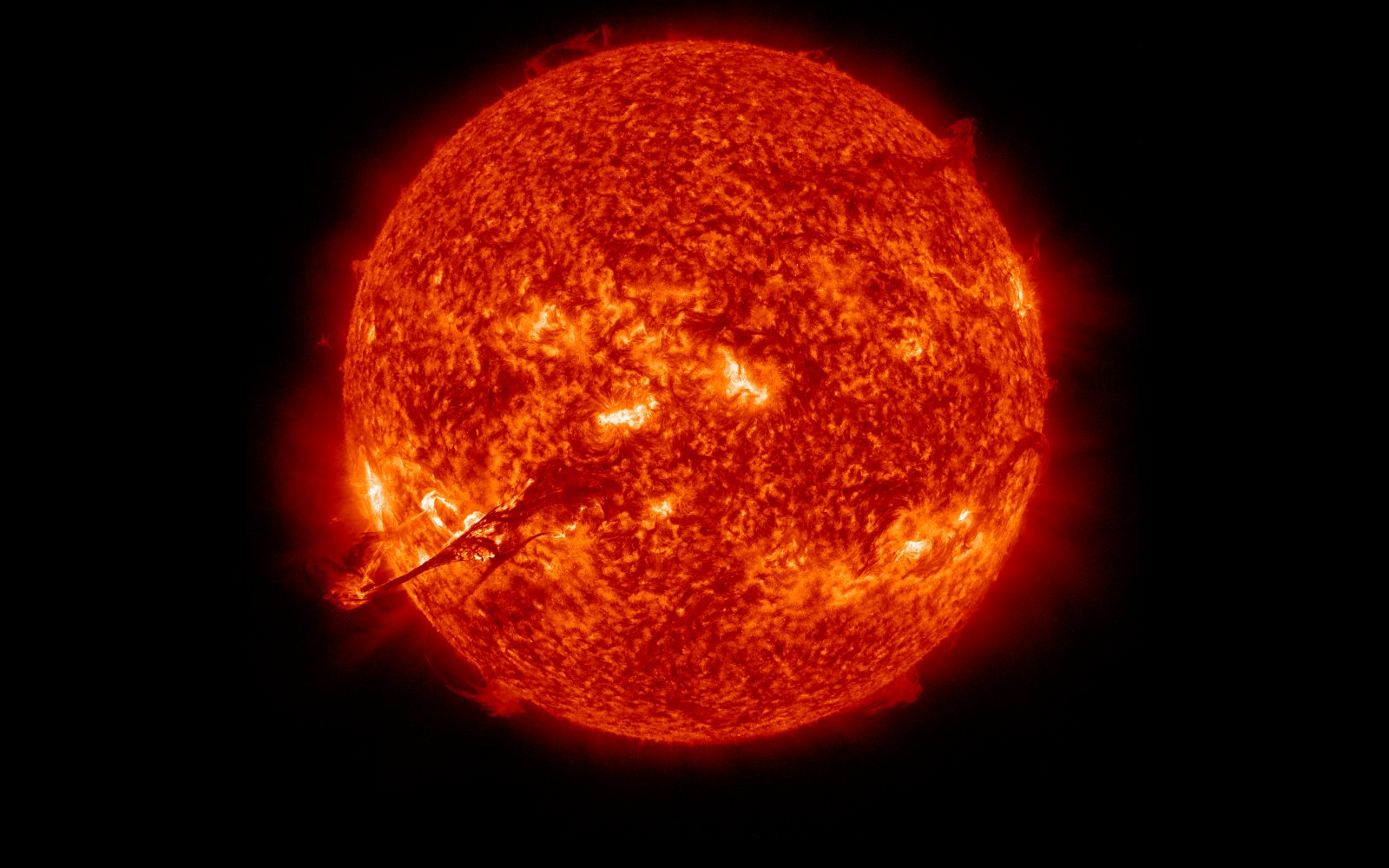
SDO 304 angstrom image of the Sun on August 31, 2012, with a long dark filament of plasma erupting from the lower left of the disk
The real thing. August 31, 2012: SDO watches a filament — that long dark thread at lower left, several hundred thousand kilometers of suspended plasma — let go of the Sun. The CME it launched left at roughly 1,400 km/s and delivered a glancing blow to Earth three days later, with aurora to match. Image: NASA/SDO (AIA 304 Å) via Helioviewer.

Step 3: The snap

A twisted rope carrying that much stress can't hold forever. When the field is pushed past its limit, field lines that have been forced past each other abruptly break and reconnect into a simpler shape. That process — magnetic reconnection — converts the stored magnetic energy into heat, light, and motion in minutes.

Four-panel storyboard: a stressed twisted field over sunspots, a filament of cool plasma forming inside it, reconnection snapping beneath it with a flare flash, and the CME escaping upward as a magnetic bubble
One process, two signatures. The reconnection flash is the flare — radiation, at Earth in 8 minutes. The escaping rope-and-plasma bubble is the CME — matter, at Earth in one to three days. They're not two events; they're two outputs of the same snap.

That's why flares and CMEs so often come as a pair, and why the flare is the starting gun for our forecasts: see the flash now, expect the cloud later.

The exceptions that prove it's magnetic

The pairing isn't automatic, and the exceptions are instructive:

This is why a headline like "X-class flare erupts!" tells you almost nothing about storms by itself. The flare class measures the flash. The storm depends on whether a CME escaped, how fast, and — as you learned in Module 1 — where it's aimed.

See the machine running today

Everything on this page is visible on the live site right now:

▦ Open /live → Sun panel → Sunspots tab (today's active regions) ▦ Same panel → Chromo 304Å tab (filaments, same wavelength as the image above) ☀ Today's report: what actually launched ◐ The solar cycle: why eruptions come in seasons

Check yourself. On the Sunspots tab, find the biggest dark group on today's Sun. That's a wound-up field storing energy right now. Flip to Chromo 304Å and look for dark threads — any filament you find is a loaded spring that hasn't snapped yet.

Check yourself — Module 2

1. Why do sunspots look dark?
A sunspot's field chokes off the heat delivery from below, leaving it roughly 1,500–2,000 K cooler. It still glows — it's only dark next to the hotter surface around it.
2. Where does the energy of a flare and CME come from?
Years of differential rotation wind and stress the field like a spring. Reconnection is the snap that converts that stored magnetic energy into the flash (flare) and the launched cloud (CME) in minutes.
3. Can a CME launch without a big flare?
Flare and CME are two outputs of one magnetic process, but the split varies: confined flares flash without an escape, and stealth CMEs escape without much flash. That's why flare class alone doesn't predict storms.

Check yourself above, then continue — answers aren't stored anywhere.

© 2026 Mike DiCarlo · CME Tracker · Privacy · 𝕏 @CMETracker1