1What happened
In early August 1972 — in the declining phase of cycle 20, well past its 1968 maximum — sunspot region McMath 11976 produced a week-long barrage of major flares. The one that mattered erupted on 4 August at 06:20 UT: a flare so energetic it saturated the X-ray detectors of the era.
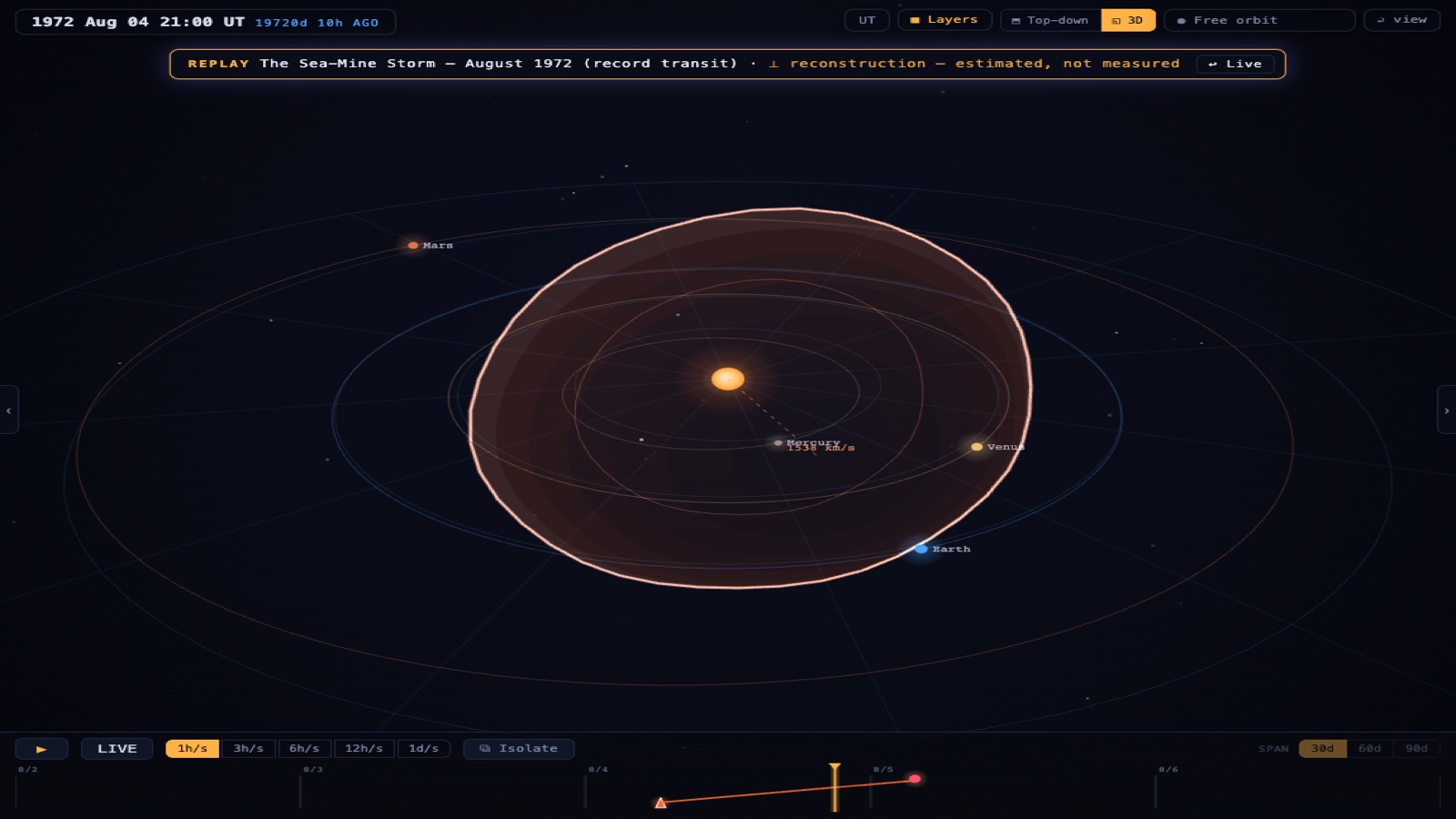
Earlier eruptions from the same region had spent the preceding days sweeping the interplanetary highway clear of slow solar wind. Into that vacuum the 4 August CME launched essentially unimpeded — and arrived at Earth at 20:54 UT the same day. Sun to Earth in ~14.6 hours: the fastest transit ever recorded, before or since. (Carrington's 1859 monster took ~17.6.)
Minutes later, aircrews of Task Force 77 flying near Hon La, North Vietnam, watched the sea erupt — dozens of US Navy Destructor mines detonating spontaneously, roughly two dozen in one thirty-second span. The mines' magnetic-influence fuzes, designed to sense a passing ship's hull, had been triggered by the storm's sudden magnetic disturbance. The Navy, after investigating, concluded the Sun had swept its minefield.
2Timeline
- 2–3 AugMcMath 11976 fires a series of major flares; their CMEs clear the Sun–Earth path — unknowingly preparing the record run.
- 4 Aug, 06:20 UTThe great flare — energetic enough to saturate detectors; a severe solar radiation storm follows.
- 4 Aug, 20:54 UTShock arrival at Earth — ~14.6 hours after launch, the fastest transit on record. Off Vietnam, sea mines begin detonating.
- 4–5 AugMeasured Kp reaches 9, yet the storm's deep signature (Dst ~−125 nT) stays moderate — the CME's magnetic field arrived pointing mostly north.
- Aug (between missions)The radiation storm falls between Apollo 16 (April) and Apollo 17 (December). Analyses since suggest a moonwalking astronaut could have absorbed a dangerous, possibly life-threatening dose.
3The science
August 1972 teaches two of this site's core lessons at once. First, transit time is set by more than launch speed: the drag-based model this tracker runs slows every CME toward the ambient solar wind, and 1972's earlier eruptions had raised that ambient dramatically — so the big one barely decelerated. Second, speed doesn't make the storm — orientation does. Despite the record transit and a measured Kp of 9, the storm's ring current barely developed (Dst only ~−125 nT), because the CME's magnetic field arrived pointing largely north, keeping Earth's magnetic gate mostly shut. It's the mirror image of St. Patrick's Day 2015, where a modest CME with a southward field punched far above its weight.
4Impacts
- The minefield. Dozens of Destructor mines off North Vietnam detonated within minutes of the shock's arrival — the storm's most cinematic documented effect, and a wake-up call about magnetic fuzing.
- Apollo's near-miss. The proton storm arrived in the four-month gap between crewed lunar missions. Inside the command module an astronaut would likely have taken a heavy but survivable dose; in a suit on the lunar surface, estimates run to radiation sickness or worse. It remains the canonical case study for crewed deep-space radiation risk.
- Communications & power. HF radio blacked out across the sunlit hemisphere; telephone and power disturbances were reported across North America, including a knocked-out long-distance cable in the US Midwest.
- The record. ~14.6 hours Sun-to-Earth has not been beaten in half a century of monitoring — the benchmark against which every fast CME (including 2012's near-miss) is measured.
5By the numbers
6What if it happened today?
A 1972-class radiation storm with astronauts on the Moon — the situation Artemis plans for — is the scenario mission planners actually drill. The transit-time lesson matters for forecasting, too: when the Sun fires several CMEs down the same corridor, the later ones arrive far earlier than a naive estimate suggests, which is exactly why this tracker models every CME against the current ambient wind rather than a fixed average. And any modern system that senses magnetic changes — from fuzes to pipelines to grid transformers — still lives in the world August 1972 revealed.
7Watch it yourself
8Sources & further reading
- Knipp, Fraser, Shea & Smart (2018), "On the little-known consequences of the 4 August 1972 ultra-fast coronal mass ejecta," Space Weather — the paper that assembled the declassified mine-detonation records.
- NASA — analyses of the August 1972 solar particle event as the reference case for Apollo-era crew radiation risk.
- Kp: GFZ Potsdam (measured). Solar wind & CME geometry: reconstructed — speed tuned so the drag model reproduces the recorded 14.6 h transit.
Get the occasional update
A short email when there's a notable solar storm or a new CME Tracker feature. No spam, unsubscribe anytime.