1What happened
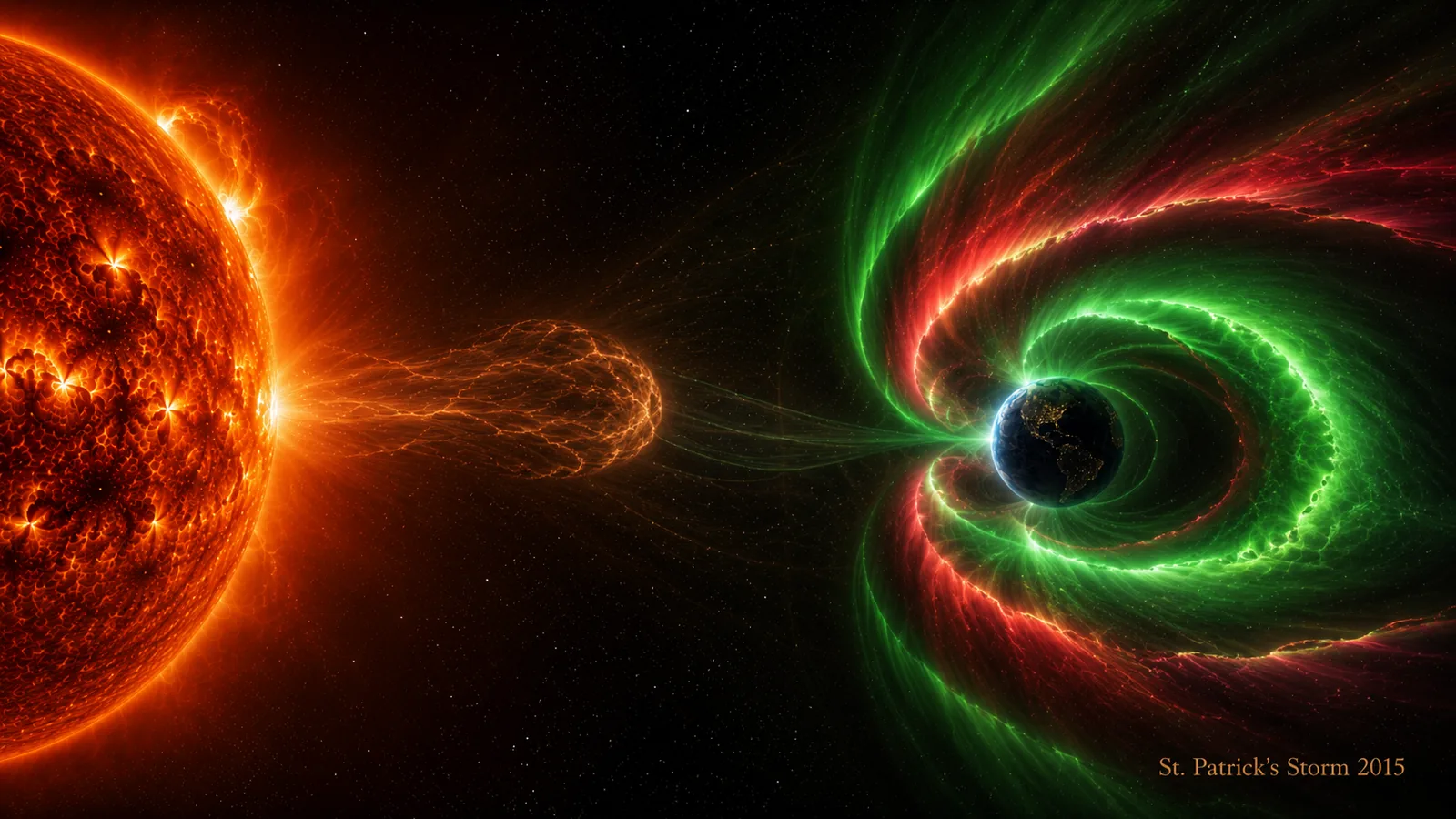
A CME left the Sun on 15 March 2015 and arrived at Earth on the 17th. On paper it was unremarkable: moderate speed, nothing like a Bastille Day halo. But the magnetic field it carried turned southward and stayed southward for an unusually long stretch, and a fast solar-wind stream arriving behind it kept the pressure on.
That sustained coupling drove the storm to G4 (severe), with Kp around 8 and the disturbance index (Dst) plunging to roughly −223 nT. It was the strongest geomagnetic storm of solar cycle 24, unmatched until the 2024 Gannon Storm (in cycle 25) nine years later. Aurora was seen well into the central United States.
2The science
This event is the counterpoint to the giant-flare storms. It shows that storm strength depends less on a CME's headline speed than on the orientation and duration of its magnetic field once it reaches Earth. A modest cloud with a long, deeply southward field can outperform a much faster one that arrives field-north.
3By the numbers
4Why it matters
For forecasters, the St. Patrick's Day storm is a humbling case: the CME's modest appearance under-sold its impact, because the decisive factor, the magnetic field orientation inside the cloud, can't be measured until it's almost here, at L1. It's a core reason CME Tracker is careful to call arrival times and storm strengths estimates, and why the highest-confidence warning only comes in the final ~30–60 minutes.
5Watch it yourself
6Sources & further reading
- NOAA SWPC: March 2015 geomagnetic storm summaries.
- Numerous studies in the AGU St. Patrick's Day 2015 literature (e.g. JGR Space Physics, 2016–2017).
- CME & flare data: NASA DONKI. Solar wind: CDAWeb OMNI. Kp: GFZ Potsdam.
Get the occasional update
A short email when there's a notable solar storm or a new CME Tracker feature. No spam, unsubscribe anytime.