1What happened
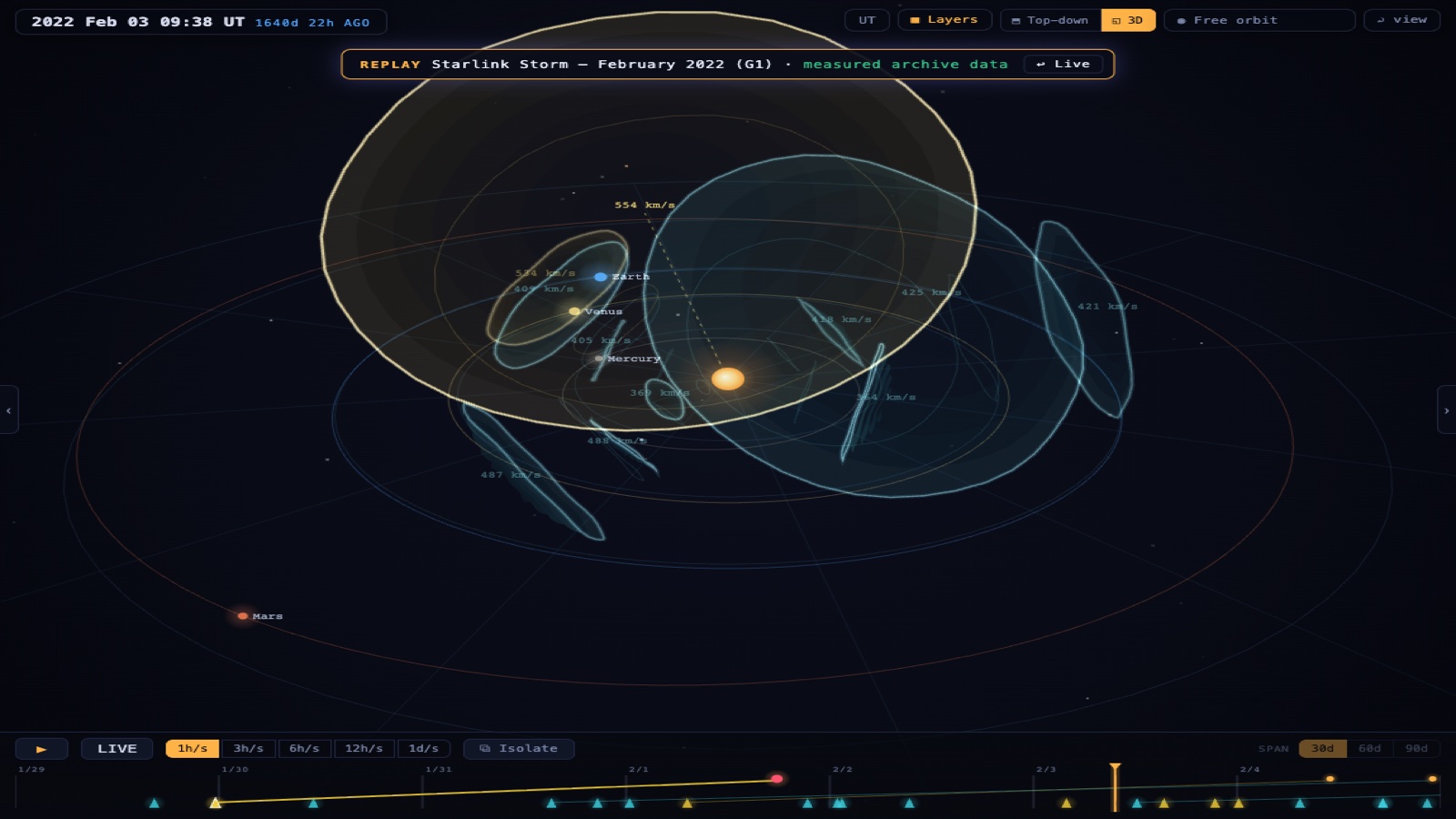
In late January 2022 the Sun produced a pair of moderate CMEs — the kind this tracker catalogs several times a month. They arrived on 2–3 February and drove two minor geomagnetic storms, peaking around G1 (Kp ~5). Nothing about the space weather made news.
On 3 February, into the middle of this, a Falcon 9 delivered 49 Starlink satellites to a deliberately low ~210 km injection orbit — a safety feature, so that any satellite that failed checkout would reenter quickly. The design assumption was ordinary drag. But a geomagnetic storm deposits energy into the thermosphere, which warms, expands upward, and thickens the air at satellite altitudes: SpaceX reported onboard measurements of drag up to 50% higher than previous launches.
The satellites were commanded into a low-drag "safe mode," flying edge-on like a sheet of paper — but most could not raise their orbits against the swollen atmosphere. 38 of the 49 reentered and burned up over the following days, streaking across Caribbean skies as some of the most-filmed artificial reentries ever. Total loss, from a storm officially classed minor.
2Timeline
- 29–30 JanModerate CMEs depart the Sun, Earth-directed — catalogued by NASA like any routine week.
- 2–3 FebArrivals drive two minor storms (peak ~G1). The thermosphere warms and swells.
- 3 Feb, 18:13 UTFalcon 9 launches 49 Starlink satellites into a ~210 km parking orbit — into ~50% higher drag than planned.
- 4–8 FebSatellites safe-mode edge-on; most can't climb. SpaceX announces up to 40 will be lost; the final count is 38.
- Following daysFireball reentries filmed over the Caribbean and elsewhere. No debris reaches the ground — the low orbit worked exactly as designed, just for the wrong reason.
3The science
Every other storm on this page did its damage through electromagnetism — induced currents, radio absorption, radiation. The Starlink storm's weapon was air. Storm energy dumped into the upper atmosphere raises its temperature, and a warmer atmosphere expands: at 200–300 km altitude, density can rise tens of percent within hours even in a minor storm. Drag scales directly with that density — and a satellite at 210 km lives on the edge of the drag budget to begin with.
4Impacts & legacy
- The fleet. 38 of 49 satellites lost — with launch costs, on the order of $50 million gone to a minor storm.
- Operations. SpaceX now weighs space-weather forecasts in launch timing and raised subsequent injection altitudes — arguably the fastest industry adaptation to a space-weather loss on record.
- The precedent. The first mass satellite loss to space weather, now the standard case study in every discussion of megaconstellation resilience — and of why thermospheric forecasting suddenly matters commercially.
- The silver lining. The low-injection safety design meant every casualty burned up harmlessly within days. The failure mode was expensive, not dangerous.
5By the numbers
6What if it happened today?
It nearly does, routinely — minor storms arrive monthly near solar maximum, and low orbits are more crowded every year. The difference is that operators now look: launch schedules shift around arrivals, and the inbound-CME warnings this site sends exist precisely because a storm's arrival time is knowable days ahead. Run the replay and watch how ordinary the CME looks — that's the point. The 2022 lesson isn't that the Sun did something rare; it's that something routine finally found a target.
7Watch it yourself
8Sources & further reading
- SpaceX (8 Feb 2022) — the company's statement on the geomagnetic storm and satellite losses.
- Hapgood et al. (2022), "Development of space weather reasonable worst-case scenarios..." and Dang et al. (2022), "Unveiling the space weather during the Starlink satellites destruction event," Space Weather.
- Fang et al. (2022), NOAA/NASA analyses of thermospheric density during the 3–4 Feb storms.
- Replay data: NASA DONKI (CMEs/flares) · CDAWeb OMNI (L1 wind) · GFZ Potsdam (Kp) — all measured.
Get the occasional update
A short email when there's a notable solar storm or a new CME Tracker feature. No spam, unsubscribe anytime.