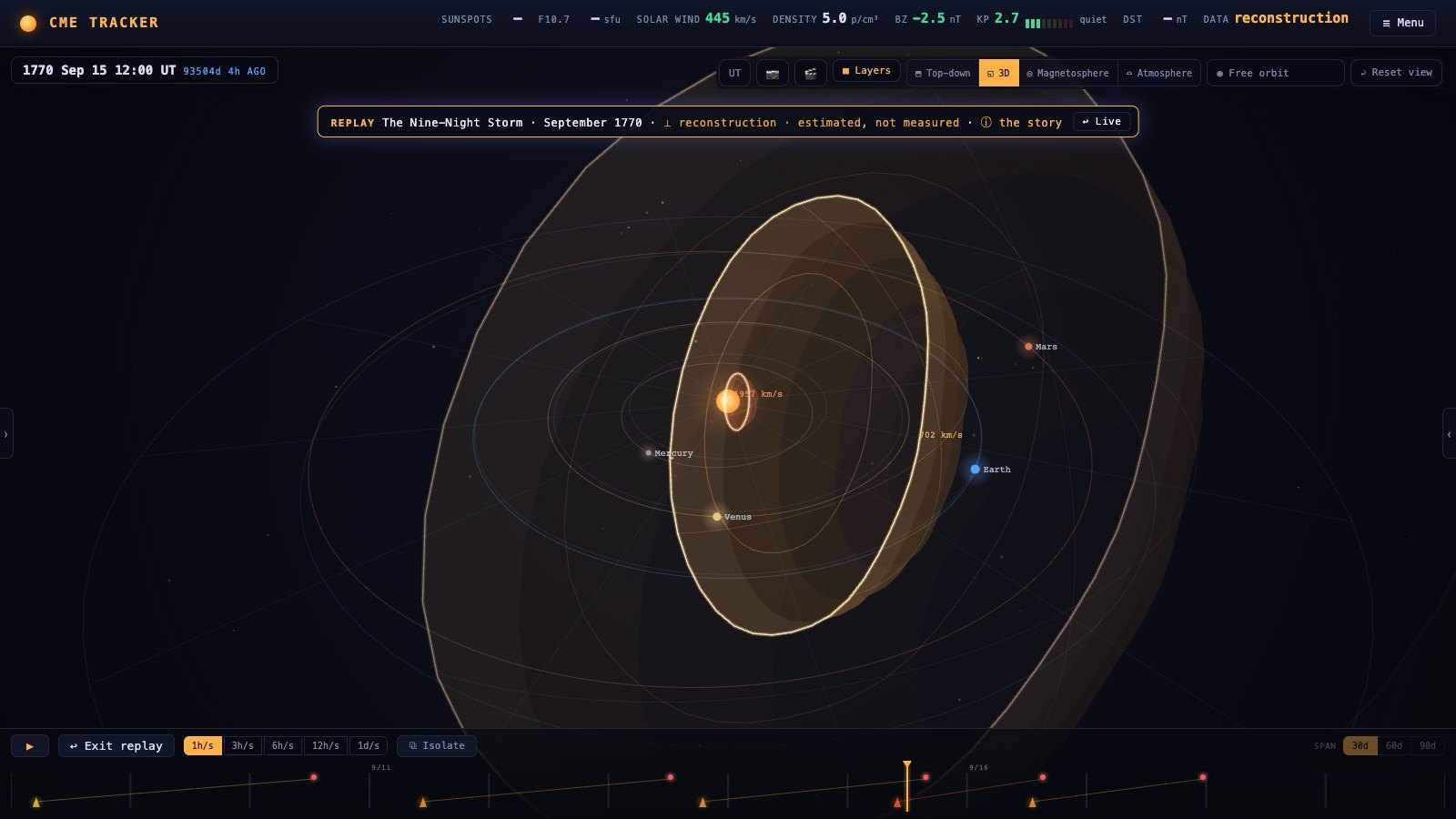
1What happened
In the second week of September 1770 an enormous sunspot group rotated onto the Sun's face. Johann Caspar Staudacher, a Nuremberg amateur who drew the Sun almost daily for nearly fifty years, sketched it from 12 to 22 September. On his 16 September drawing the group covers about 6,000 millionths of the visible hemisphere. That is more than twice the area of the group behind the Carrington event, and in the same class as the largest sunspot group ever measured, in April 1947. In Japan people saw it with the naked eye.
What the group did is written in 111 diaries, official histories and local chronicles from Japan and China. Starting on the night of 10 September, red light filled the northern sky at latitudes that almost never see aurora. It came back the next night, and the next. Apart from one clear gap on 12 September, low-latitude aurora was reported every night through 19 September. The peak came on 16 to 18 September, when contemporary drawings show vivid red covering a wide sweep of the sky over Kyoto.
The most equatorward report is from Dongting Lake in Hunan, China, on 17 September, at just 18.8° magnetic latitude. The night before, HMS Endeavour was crossing the Timor Sea on her way home from Australia. Joseph Banks and Sydney Parkinson, the expedition's naturalist and artist, logged an aurora "reaching in height about twenty degrees above the horizon" at 20.6° south magnetic latitude. Put those two reports together and the auroral oval reached about as far toward the equator as it did in 1859. It simply stayed there far longer.
2Timeline
- 10 SeptemberFirst red aurora over Japan and China. In the replay, the opening CME from the group near the eastern limb arrives.
- 12 SeptemberThe one quiet night in ten. Staudacher begins drawing the giant group as it rotates into view.
- 13 – 15 SeptemberAurora resumes and builds as the group swings toward disk center, firing at Earth.
- 16 SeptemberThe main blow. Endeavour's crew logs aurora 20 degrees high off Timor, 20.6° south magnetic latitude.
- 17 SeptemberPeak night. Aurora reported from Dongting Lake at 18.8° magnetic latitude; vivid red drawings from Kyoto. A follow-up CME rides into the wake of the first.
- 18 – 19 SeptemberThe storm eases over two more nights of aurora, then the sky finally clears.
3The science
A single CME, however violent, gives you a storm that peaks in hours and recovers in a day or two. Nine nights of extreme aurora is something else. The only way to keep the magnetosphere that compressed for that long is to hit it again and again, and the sunspot record says exactly that: a group that size, at disk center, carrying that much magnetic energy, launches eruptions in bursts. Hayakawa and colleagues concluded that the spots "likely ejected several huge, sequential magnetic structures in short duration." Each one arrived into the wind its predecessor had already cleared, which is the same wake effect that made the second CME of 1921 and the Gannon barrage of 2024 hit so hard.
How strong was it? There is no magnetometer trace, so the storm's intensity is inferred from where the aurora reached. The oval's edge is a well-tested proxy: the farther equatorward the red glow, the stronger the ring current. With reports at 18.8° north and 20.6° south, the 1770 storm sits with 1859 as the most extreme in the historical record. Ebihara and colleagues modeled the 17 September display separately and reached the same conclusion. The honest statement is that its intensity is comparable to Carrington's and its duration has no equal.
4Impacts
- Nothing to break. In 1770 there was no telegraph, no grid, nothing electrical for a storm to burn. The impact was the sky itself, and the record of it is the storm's legacy.
- The first two-hemisphere aurora. Banks and Parkinson on Endeavour, and the diarists of Japan and China, watched the same storm on the same nights. It is the earliest known simultaneous record of aurora in both hemispheres.
- A memory that lasted 89 years. When the Carrington aurora lit Japan in 1859, a chronicler there noted that the sky looked the way it had in 1770. Extreme storms recur, and someone noticed before science did.
- A year of activity. The same group, or its descendants, kept the Sun busy: more low-latitude aurora was recorded in East Asia in mid-October 1770, and the elevated activity lasted about a year.
5By the numbers
6What if it happened today?
The planning studies model 1921 and 1859 as a single extreme hit followed by recovery. 1770 breaks that assumption. A week of repeated Carrington-class arrivals means transformers never cool between geomagnetically induced current surges, satellite operators never get a quiet window to recover spacecraft from safe mode, and the swollen upper atmosphere keeps dragging on low orbits night after night. Aurora would be visible from the Caribbean and northern Australia for most of a week. The one mercy is warning time: with a group that size at disk center, every eruption would be seen leaving the Sun a day or more before it arrived, which is exactly what this tracker is built to show.
7Watch it yourself
8Sources & further reading
- Hayakawa, Iwahashi, Ebihara et al. (2017), "Long-lasting extreme magnetic storm activities in 1770 found in historical documents," The Astrophysical Journal Letters 850, L31. The 111-record survey, the magnetic latitudes, and the Staudacher sunspot measurement behind this page.
- Ebihara, Hayakawa, Iwahashi et al. (2017), "Possible cause of extremely bright aurora witnessed in East Asia on 17 September 1770," Space Weather 15. The modeling of the peak night.
- Willis, Stephenson & Singh (1996) on the Endeavour aurora record; Joseph Banks, The Endeavour Journal (ed. Beaglehole, 1962); Sydney Parkinson, A Journal of a Voyage to the South Seas (1773).
- Arlt (2008), the digitized Staudacher sunspot drawings, 1749 to 1796.
- Everything in the replay is reconstructed. No measurements of any kind existed in 1770, so the CMEs, wind and Kp are authored to fit the aurora record, not measured.
Get the occasional update
A short email when there's a notable solar storm or a new CME Tracker feature. No spam, unsubscribe anytime.