1What happened
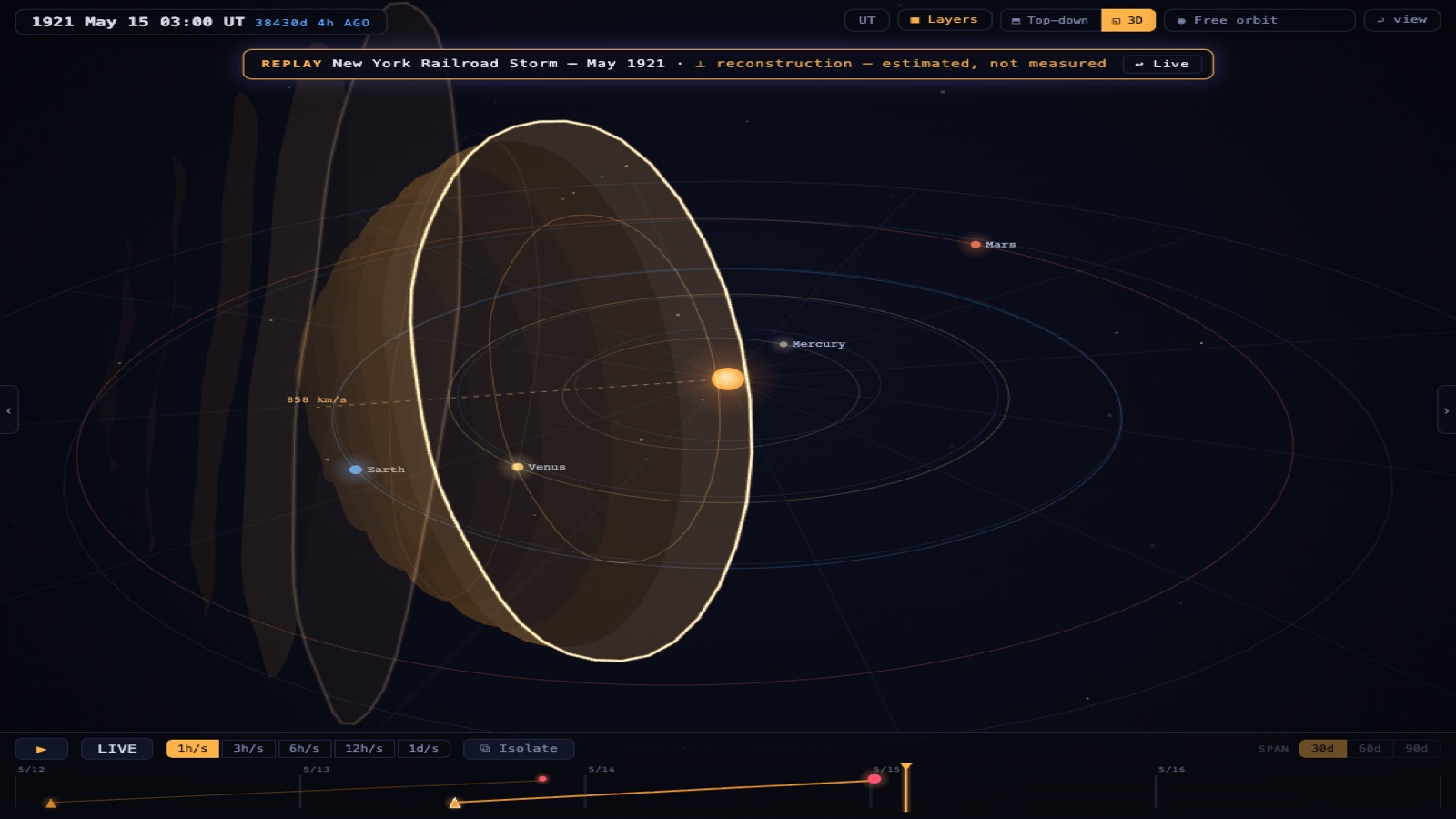
In mid-May 1921 an enormous sunspot group — easily visible to the (protected) naked eye — rotated across the center of the solar disk. Beginning on 12 May it launched a sequence of Earth-directed CMEs. Magnetometers recorded two sudden commencements: one on 13 May (~13 UT), and the killer on 14 May at 22:12 UT — a second CME that had raced through the wake its predecessor cleared, the same one-two pattern behind 2003's Halloween storms and 2024's Gannon storm.
The main phase that followed, peaking in the early hours of 15 May, was ferocious. Modern reconstruction from surviving magnetograms (Love et al., 2019) puts the storm's intensity near Dst −907 ± 132 nT — half again deeper than the 1989 Quebec storm, and within reach of Carrington itself.
The name comes from what it did on the ground: geomagnetically induced currents surged through telegraph and signal wires until they smoked. In New York, the Central Railroad's signal and switching system at 57th Street failed and its control tower caught fire; a telegraph-office fire in Brewster, NY burned the building down; in Karlstad, Sweden, a telephone exchange went up. Aurora was reported from Samoa and Puerto Rico — deep in the tropics, the classic signature of a superstorm.
2Timeline
- 10–12 MayA giant sunspot group crosses disk center — perfectly placed to fire at Earth.
- 13 May, ~13 UTFirst sudden commencement: the opening CME arrives, disturbing telegraph lines and lighting high-latitude aurora.
- 14 May, 22:12 UTThe main CME arrives through its predecessor's wake. The great storm begins.
- 15 May, ~02–03 UTPeak of the century's deepest storm (est. Dst ≈ −900 nT). Aurora to Samoa; telegraph systems burning out across the US and Europe.
- 15 May (morning, NY)The New York Central Railroad's signal system fails; its 57th Street control tower catches fire. The storm gets its name.
3The science
1921 is the strongest evidence that Carrington was not a fluke. Sixty-two years apart, the Sun produced two storms of comparable violence — which is exactly the sampling you'd expect if such storms recur on a roughly once-a-century timescale. The multi-CME structure matters too: the first eruption clears and compresses the interplanetary medium so the follow-up arrives faster and hits harder — the pattern this tracker's drag model captures by propagating every CME against the ambient wind its predecessors modified.
4Impacts
- Railroads & telegraphs. The NY Central's signal system burned at 57th Street; telegraph service failed across the eastern US and much of Europe; undersea cable operations were disrupted.
- Fires. At least three documented space-weather fires — the New York signal tower, the Brewster telegraph office, and Sweden's Karlstad telephone exchange — still the clearest cases of a storm igniting infrastructure.
- Aurora. Reported at Samoa (~15° geomagnetic latitude) and Puerto Rico, and bright enough over the US East Coast to read by.
- The warning. 1921 hit a telegraph civilization. The same storm today lands on continental power grids, GPS timing, and satellite fleets — which is why it anchors modern worst-case planning studies.
5By the numbers
6What if it happened today?
This is the storm the insurance and grid-planning studies actually model, because unlike Carrington it comes with measured magnetograms. A 1921-class event today is projected to stress or damage high-voltage transformers across mid-latitudes, degrade GPS and HF for days, and force large satellite constellations into safe modes — while also producing the most spectacular aurora in living memory. The mitigation is the same one this site exists to demonstrate: the CME takes a day or more to arrive, and a day of accurate warning is worth a great deal.
7Watch it yourself
8Sources & further reading
- Love, Hayakawa & Cliver (2019), "Intensity and impact of the New York Railroad superstorm of May 1921," Space Weather — the modern intensity reconstruction.
- Hapgood (2019), "The great storm of May 1921: An exemplar of a dangerous space weather event," Space Weather — the shock-timing analysis behind this replay's two CMEs.
- Contemporary reporting: The New York Times, 15–17 May 1921 (railroad and telegraph accounts).
- Everything in the replay is reconstructed — no interplanetary measurements existed in 1921; estimated values, not measured.
Get the occasional update
A short email when there's a notable solar storm or a new CME Tracker feature. No spam, unsubscribe anytime.