1What happened
In mid-May 1967 an unusually large and magnetically twisted sunspot group crossed the Sun's face. On 23 May it produced one of the great flares of the century — visible in white light, and accompanied by solar radio bursts among the most intense ever recorded, on exactly the frequencies used by the US Ballistic Missile Early Warning System.
All three BMEWS sites — Thule (Greenland), Clear (Alaska), and Fylingdales (England) — were degraded or blinded at once. In 1967 doctrine, deliberately jamming those radars meant one thing: a Soviet attack was imminent. Additional nuclear-armed bombers were readied. What stopped the escalation was information: the Air Force had, only years earlier, stood up a small solar-forecasting operation, and its forecasters — who had watched the flare erupt in near-real time — convinced commanders the "jamming" was coming from the Sun.
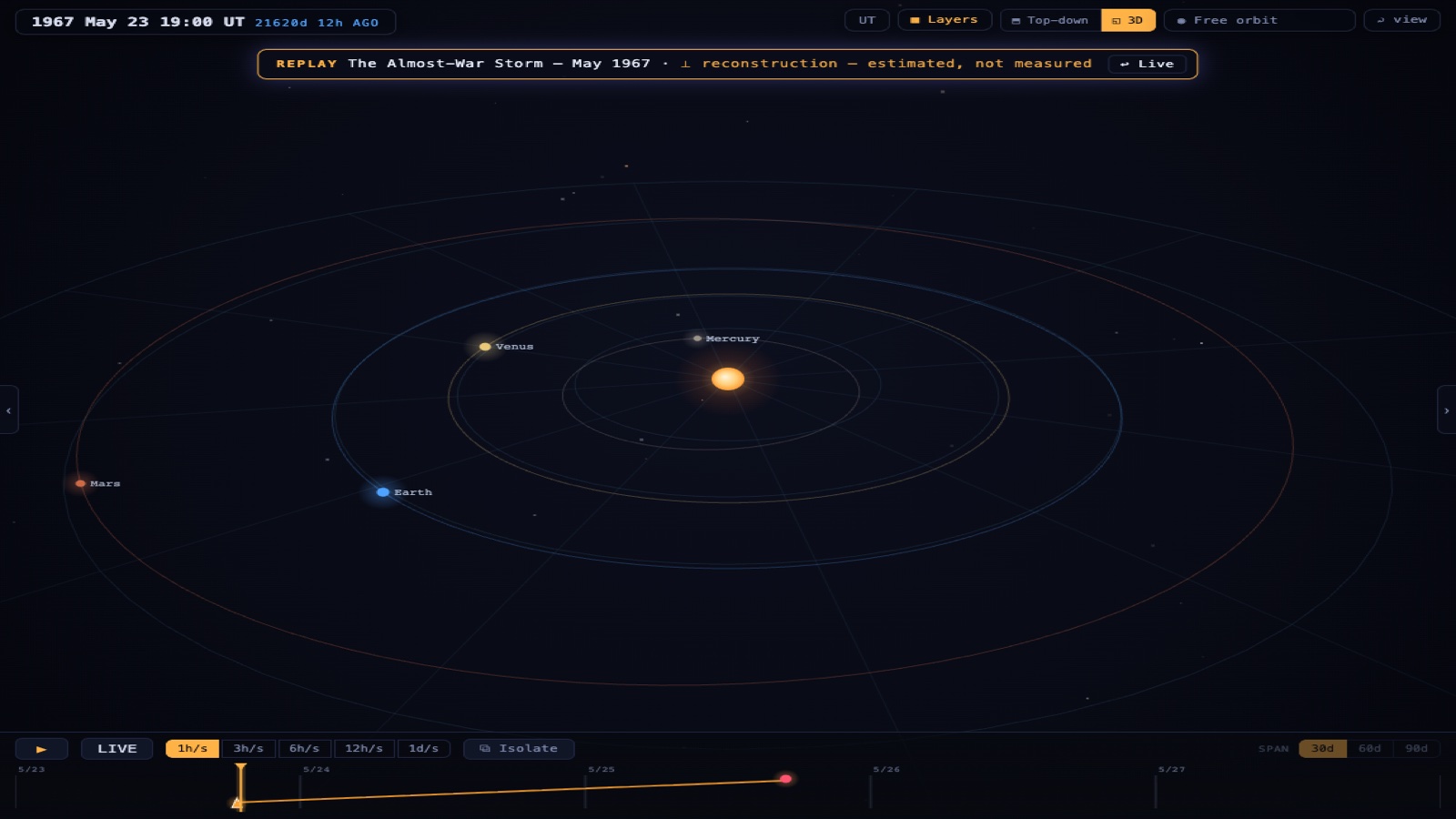
The Sun wasn't finished. The flare's CME arrived about 41 hours later, on 25 May, and drove one of the great geomagnetic storms of the century — the measured Kp sequence in this replay reaches 9. Aurora was seen as far south as New Mexico, and radio communications were disrupted worldwide for days — including, at times, the very HF links the bombers would have relied on.
2Timeline
- 18–22 MayA giant, magnetically complex sunspot region rotates into an Earth-facing position; forecasters flag it as dangerous.
- 23 May, ~18:40 UTThe great flare erupts — white-light visible, with radio bursts intense enough to swamp radar receivers.
- 23 May, afternoon (US)All three BMEWS sites degraded at once; the jamming is initially treated as hostile. Additional alert aircraft are readied before AWS forecasters identify the Sun as the source.
- 25 May, ~12 UTThe CME arrives — the geomagnetic storm commences.
- 25–26 MayGreat-storm main phase: measured Kp reaches 9; aurora to the southern US; worldwide radio disruption for days.
3The science
The near-war moment wasn't caused by the CME at all — it was caused by the flare's solar radio bursts, broadband radio noise generated by electrons accelerated in the flare. When the Sun sits in a radar's field of view and shouts on its frequency, the radar hears jamming. The CME's geomagnetic storm was the second, slower act — arriving two days later, the classic two-wave pattern this site tracks.
4Impacts & legacy
- The near-launch. The event is documented in Knipp et al. (2016): commanders readied additional alert aircraft before the solar explanation arrived. It's regarded as the strongest case of space weather nearly triggering armed conflict.
- Radio. The storm disrupted HF communications worldwide for nearly a week — a preview of how a great storm degrades exactly the backup systems a crisis needs.
- The legacy. May 1967 transformed US military space-weather forecasting from a curiosity into an operational requirement — the institutional ancestor of today's warning systems (and, distantly, of hobby trackers like this one).
- Aurora. Seen across the southern United States — reported from New Mexico under a Kp 9 sky.
5By the numbers
6What if it happened today?
The specific failure mode is largely fixed — modern early-warning systems account for the Sun in their fields of view, and solar radio bursts are monitored in real time. The general lesson aged better than the specifics: in a crisis, space weather degrades radar, HF radio, and GPS at exactly the moment humans are primed to read malfunctions as attacks. Attribution — knowing the Sun did this, quickly — remains the whole game, and it's why the flare layer in this tracker is timed to the minute.
7Watch it yourself
8Sources & further reading
- Knipp et al. (2016), "The May 1967 great storm and radio disruption event: Extreme space weather and extraordinary responses," Space Weather — the definitive account, built on interviews with the forecasters involved.
- NOAA NCEI — historical solar-terrestrial records for May 1967.
- Kp: GFZ Potsdam (measured — the real great-storm sequence). Solar wind & CME geometry: reconstructed from event records (see the callout above).
Get the occasional update
A short email when there's a notable solar storm or a new CME Tracker feature. No spam, unsubscribe anytime.