1What happened
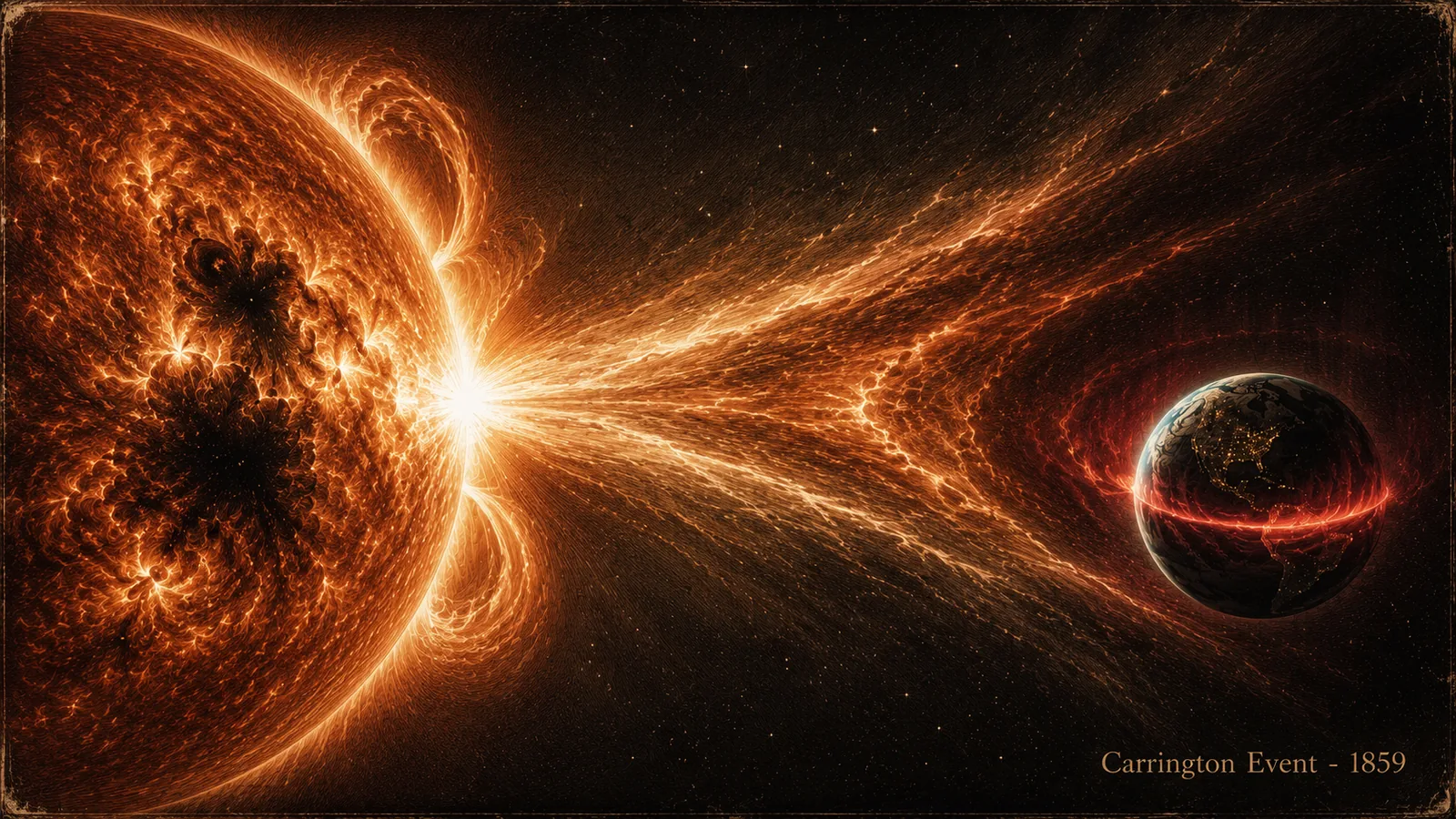
On the morning of 1 September 1859, English astronomer Richard Carrington was sketching sunspots when he saw two brilliant beads of white light flare up over the group. Across town, Richard Hodgson saw the same thing. It was the first solar flare ever observed, a flash so intense it was visible in ordinary white light.
Less than a day later, the storm struck Earth. That is remarkably fast, implying an exceptionally quick CME (perhaps cleared by an earlier eruption). In the early hours of 2 September, magnetic instruments swung wildly, telegraph networks across Europe and North America failed, and in places operators reported sparks leaping from their equipment. Some lines kept working with their batteries disconnected, driven by the electric currents the storm itself induced.
Overhead, the sky lit up. Aurora, normally a polar sight, was reported near the equator: the Caribbean, Colombia, Hawaii, and Queensland. People rose in the night believing it was dawn.
2Timeline
- 1 Sept, ~11:18 UTCCarrington and Hodgson independently witness the first white-light solar flare.
- ~17.6 hours laterAn exceptionally fast CME crosses the Sun–Earth distance, one of the shortest transits ever inferred.
- 2 Sept (early hours)The storm peaks. The Colaba observatory in Bombay records an enormous magnetic deflection; telegraphs fail worldwide.
- 2 Sept (night)Aurora is seen close to the equator; observers report being able to read newsprint by its light.
3The science
What made 1859 extreme wasn't only the eruption's speed but the chain of conditions behind it. A very fast, Earth-directed CME drove a strong shock; the cloud it carried held an intense, sustained southward magnetic field, which coupled enormous energy into Earth's magnetosphere. The result was a geomagnetic disturbance far beyond anything in the modern record.
Our best single measurement is the Colaba magnetogram from Bombay, which recorded a horizontal-field drop of roughly 1,600 nanotesla. Estimates of the storm's intensity vary widely precisely because the instrumentation of the day was sparse, which is why everything here is labeled a reconstruction, not a measurement.
4Impacts
- Telegraph chaos. The era's one electrical network failed across two continents; some operators were shocked, and induced currents let a few lines run with no batteries at all.
- Aurora to the tropics. The lights reached the Caribbean and other low latitudes, far outside their normal range.
- A glimpse of our vulnerability. In 1859 there was little electrical infrastructure to damage. Today the same storm would stress continent-scale power grids, satellites, GPS, and aviation, which is exactly why the event remains so closely studied.
5By the numbers
Values are estimates reconstructed from historical records, not instrument data.
6What if it happened today?
This is the question that keeps space-weather scientists up at night. Studies of a modern Carrington-class storm warn of widespread, possibly long-duration damage to high-voltage transformers, satellite losses, GPS and aviation disruption, and economic costs running into the hundreds of billions to trillions of dollars. The good news is that we'd see it coming. That's the entire point of the spacecraft and forecasting systems this tracker draws on. The hard part is hardening the grid before, not after.
7Watch the reconstruction
Because no instruments existed in 1859, the replay uses an authored CME (an estimated ~2,300 km/s Earth-directed eruption) and a synthesized storm consistent with the historical accounts, clearly flagged as a reconstruction throughout. It's a way to feel the timescale: a flash on the Sun, then under a day later, the sky on fire.
8Sources & further reading
- Carrington, R. C. (1859), “Description of a Singular Appearance seen in the Sun,” MNRAS 20, 13.
- NOAA NESDIS: What Was the Carrington Event?
- Tsurutani et al. (2003), reconstruction of the 1859 storm from the Colaba magnetogram, J. Geophys. Res.
- Reconstruction in this replay: authored CME geometry + synthesized storm from historical records. Estimated, not measured.
Get the occasional update
A short email when there's a notable solar storm or a new CME Tracker feature. No spam, unsubscribe anytime.