1What happened
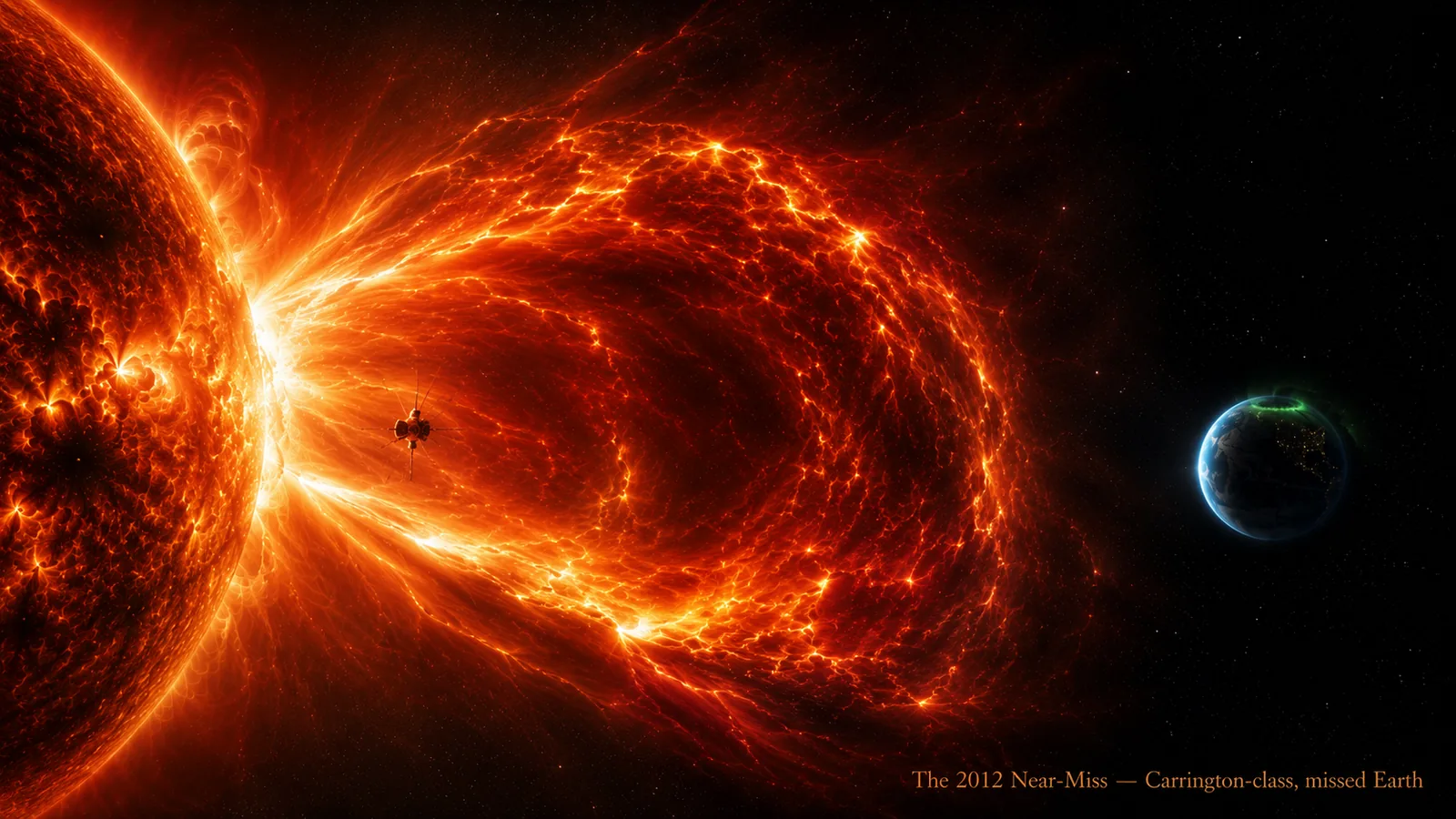
On 23 July 2012, active region AR 11520 erupted with one of the fastest CMEs ever catalogued. Published estimates put it around 2,500–3,000 km/s, in Carrington territory. It crossed the Sun-to-Earth distance in well under a day.
But Earth wasn't there. The eruption was aimed roughly 120° away from our planet, and it swept across the orbit into empty space, striking instead the STEREO-A spacecraft, which happened to be parked along its path. STEREO-A measured the full fury of the storm in situ: a total magnetic field peaking near 109 nT, with a deep, sustained southward component around −50 nT, field strengths far beyond anything measured at Earth in the modern era.
The unsettling part is the timing. The same region had been pointed at Earth roughly nine days earlier. Had it erupted then, this would likely be remembered as the modern Carrington Event.
2The science
This event is the clearest possible demonstration of the single idea at the heart of CME Tracker: geometry decides everything. The storm's intensity was Carrington-class. Its impact on Earth was nil. Earth wasn't inside the cone.
It also showed the value of a second vantage point. Because STEREO-A views the Sun from off to the side, it both helped reveal the CME's true speed and direction and served as an accidental probe of the storm itself, a natural experiment in what a direct hit would have delivered.
3By the numbers
4What if it had hit?
A widely-cited 2013 analysis concluded that a direct hit would have produced a geomagnetic storm rivaling or exceeding 1859, with the attendant risk to grids, satellites, and GPS. A frequently-quoted estimate from Pete Riley put the odds of a Carrington-class storm striking Earth at roughly 12% per decade. In other words, the 2012 event wasn't a freak: it was a reminder that the dice are still being rolled, and that aim is the only thing standing between a near-miss and a direct hit.
5Watch it yourself
6Sources & further reading
- Baker et al. (2013), “A major solar eruptive event in July 2012,” Space Weather 11, 585.
- Riley, P. (2012), “On the probability of occurrence of extreme space weather events,” Space Weather 10.
- NASA: Near Miss: The Solar Superstorm of July 2012
- CME: NASA DONKI. STEREO-A in situ: CDAWeb. Earth wind/Kp: CDAWeb OMNI / GFZ (quiet: Earth was missed).
Get the occasional update
A short email when there's a notable solar storm or a new CME Tracker feature. No spam, unsubscribe anytime.