The Sun's August: a meteor shower, and the eclipse that shares its Moon
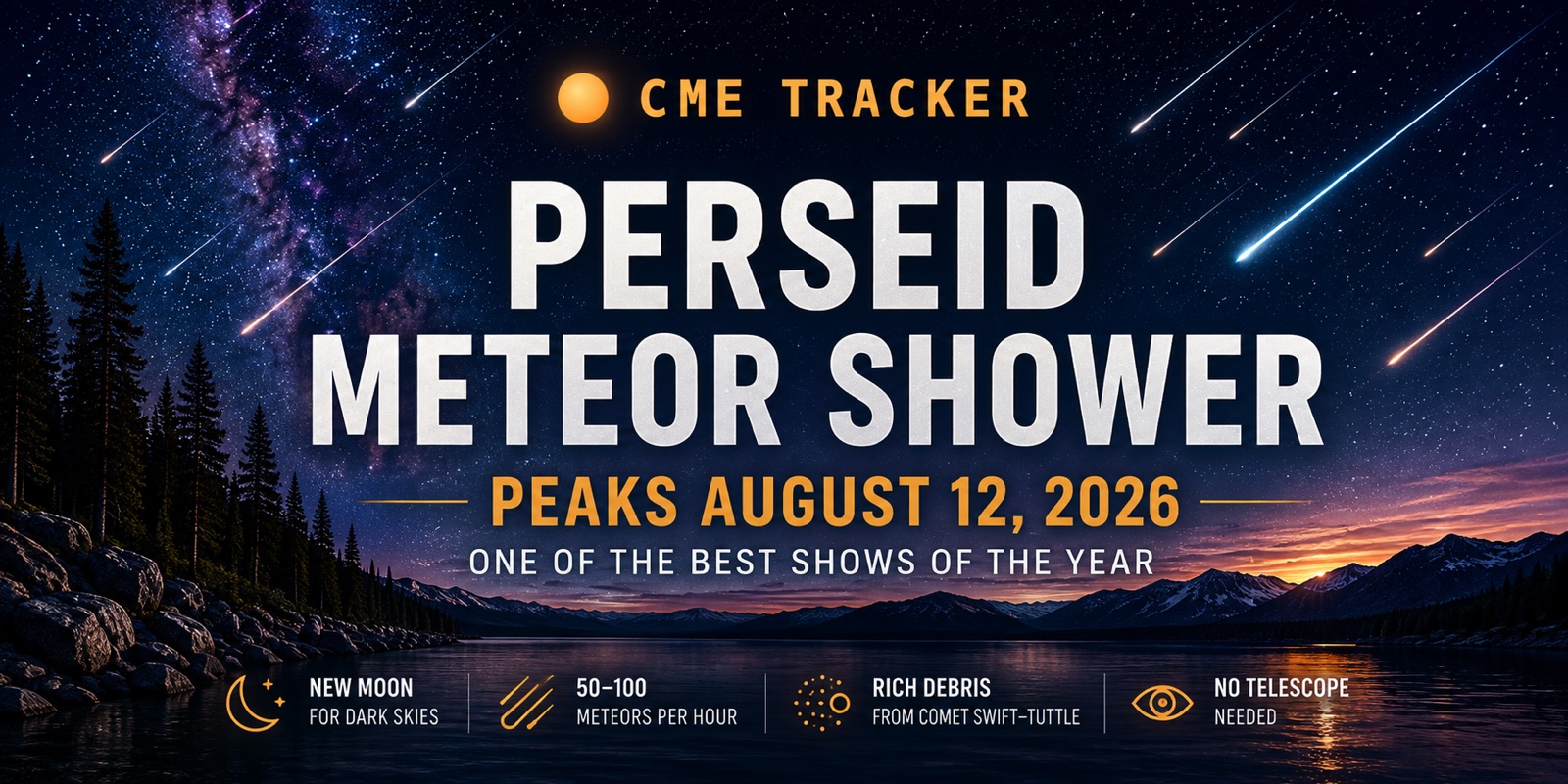
On the night of August 12, 2026, the Perseid meteor shower hits its peak under the darkest skies it gets — up to 50–100 shooting stars an hour, no telescope needed. And it's no accident the sky is so dark: the Moon that night is a whisker-thin sliver — ~2% lit, setting around 11 PM — so it's dark the rest of the night, and that very same new Moon also slides in front of the Sun that day, throwing a total solar eclipse across Iceland and Spain. One new Moon, two of the year's best sky events.
1The Perseids — the one to actually go outside for
The Perseids are the debris trail of comet 109P/Swift–Tuttle: every August, Earth plows through the dust it has shed, and those specks hit the atmosphere at ~59 km/s (37 miles a second) and burn up as shooting stars. The comet swings around the Sun every 133 years, and Earth crosses its debris every year from July 17 to August 24, with the peak on Aug 12–13. The particles burn up about 60 miles (100 km) up, and the Perseids are famous for bright fireballs that leave glowing trains hanging in the sky.
2026 is a banner year for a simple reason: in many years a bright Moon shares the peak and washes the fainter meteors out. This year the new Moon falls on the peak itself, so the sky is as dark as it ever gets — NASA calls the viewing "ideal." That's why this one is worth planning around.
2How to watch (it's genuinely easy)
- When: after midnight into the pre-dawn hours of Aug 13 is best, when the radiant in the constellation Perseus climbs high in the northeast. You'll catch meteors earlier in the evening too, just fewer.
- Where: get away from city lights. A dark location with an open horizon makes an enormous difference — this is the whole reason the new Moon matters.
- How: no telescope, no binoculars — they narrow your view. Lie back, take in as much sky as you can, and give your eyes 20–30 minutes to fully dark-adapt (and keep them adapted — a phone screen resets it).
- Look: generally toward Perseus in the northeast, but meteors streak across the whole sky, so a wide view beats staring at one spot.
3The eclipse — the Sun's half of the story
A solar eclipse can only happen at new Moon — the Moon has to pass directly between Earth and the Sun. So the new Moon that darkens the Perseid sky on August 12 is the same one that produces a total solar eclipse that day, the first totality over parts of Europe in years.
Can I see it from the US? Honestly — no. Totality crosses the Arctic, Greenland, Iceland and northern Spain, and the partial phases reach Europe, North Africa and the far north of Canada. The contiguous United States, Alaska and Hawaii are outside it entirely. So for most of us the eclipse is the day's great story, and the Perseids are the night's great show. (If the Sun is more your thing than shooting stars, the eclipse is squarely our world — the same Sun we track for storms every day. Watch it live on the tracker.)
Get the heads-up for the next one
We mostly send alerts about solar storms and the aurora — but when the sky's got something worth clearing your calendar for, subscribers hear about it. No spam, unsubscribe anytime. (Privacy: we store your address and nothing else.)
4Sources
- NASA — Watch the Perseids with NASA (peak timing, new-Moon conditions, 50–100/hr).
- Eclipse path, duration and visibility: total solar eclipse of August 12, 2026 (totality over Greenland, Iceland, and northern Spain).