1What happened
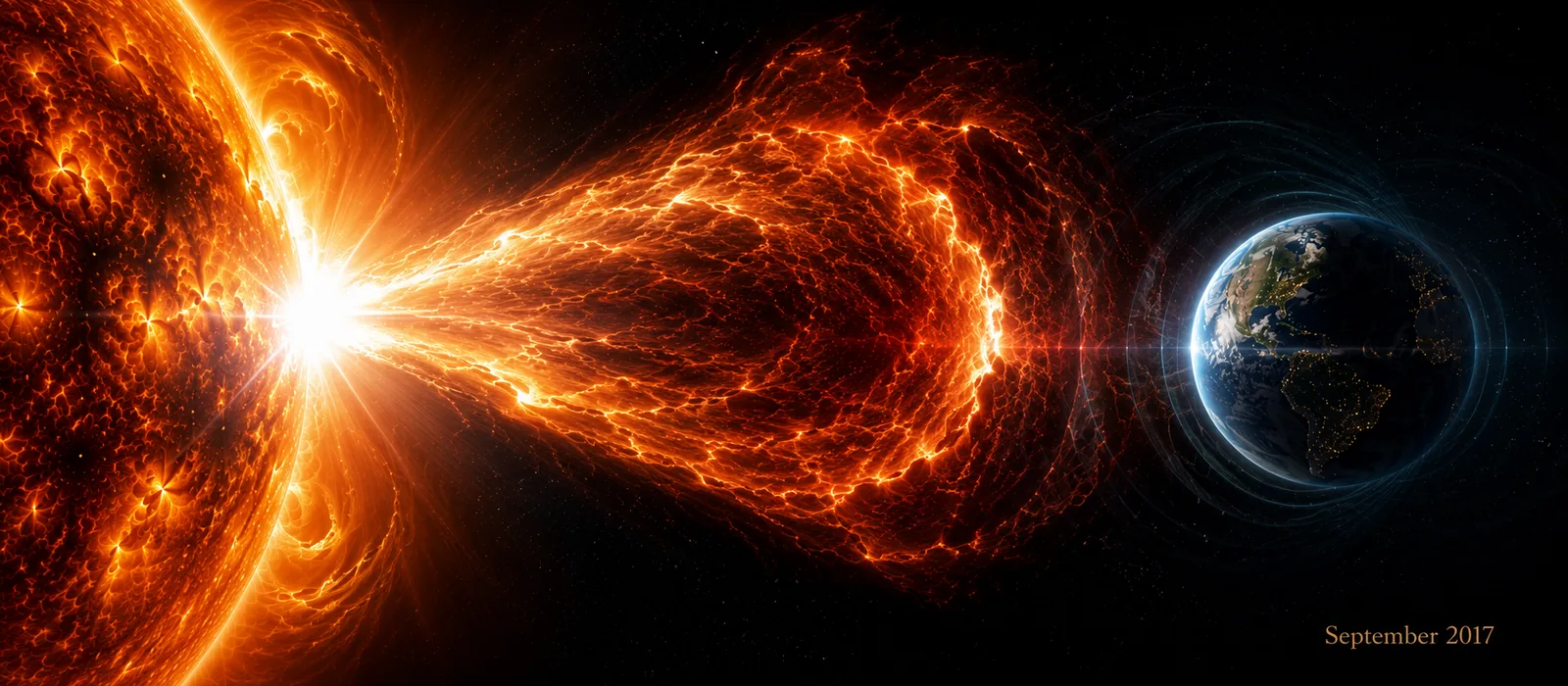
In early September 2017, region AR 2673 grew explosively. On 6 September it produced an X9.3 flare, the largest of solar cycle 24, and on 10 September an X8.2 flare off the Sun's western edge that drove a strong solar radiation storm.
A fast CME from the 6 September eruption (around 1,500–2,000 km/s near the Sun) reached Earth on 7–8 September, driving a severe G4 storm with aurora seen across the northern United States, unusually far south for the time of year. (The truly extreme speed of the week, roughly 2,650–3,000 km/s, belonged to the 10 September limb eruption, which was aimed largely away from Earth.)
2The science
September 2017 is a reminder that solar maximum isn't required for a serious storm. The Sun was already past the peak of a weak cycle, yet one complex region delivered cycle-defining flares. It also showcased the full hazard stack: X-ray flares causing immediate radio blackouts, a solar radiation storm from energetic protons, and a geomagnetic storm from the CME a day later.
3Impacts
- Radio blackouts at the worst time. The flares' X-rays caused high-frequency radio blackouts over the sunlit Earth, degrading HF communications relied on for emergency and aviation traffic during Hurricanes Irma, Jose, and Katia.
- Radiation storm. The 10 September limb flare drove a strong solar proton event, a radiation concern for high-altitude flights and satellites.
- Aurora. The G4 storm pushed aurora into the northern United States.
4By the numbers
5Watch it yourself
6Sources & further reading
- NOAA SWPC: September 2017 space weather event summaries.
- NASA: Major Solar Flare: SDO views of the 6 September 2017 X9.3
- Redmon et al. (2018), “September 2017's Geoeffective Space Weather,” Space Weather.
- CME & flare data: NASA DONKI. Solar wind: CDAWeb OMNI. Kp: GFZ Potsdam.
Get the occasional update
A short email when there's a notable solar storm or a new CME Tracker feature. No spam, unsubscribe anytime.