1What happened
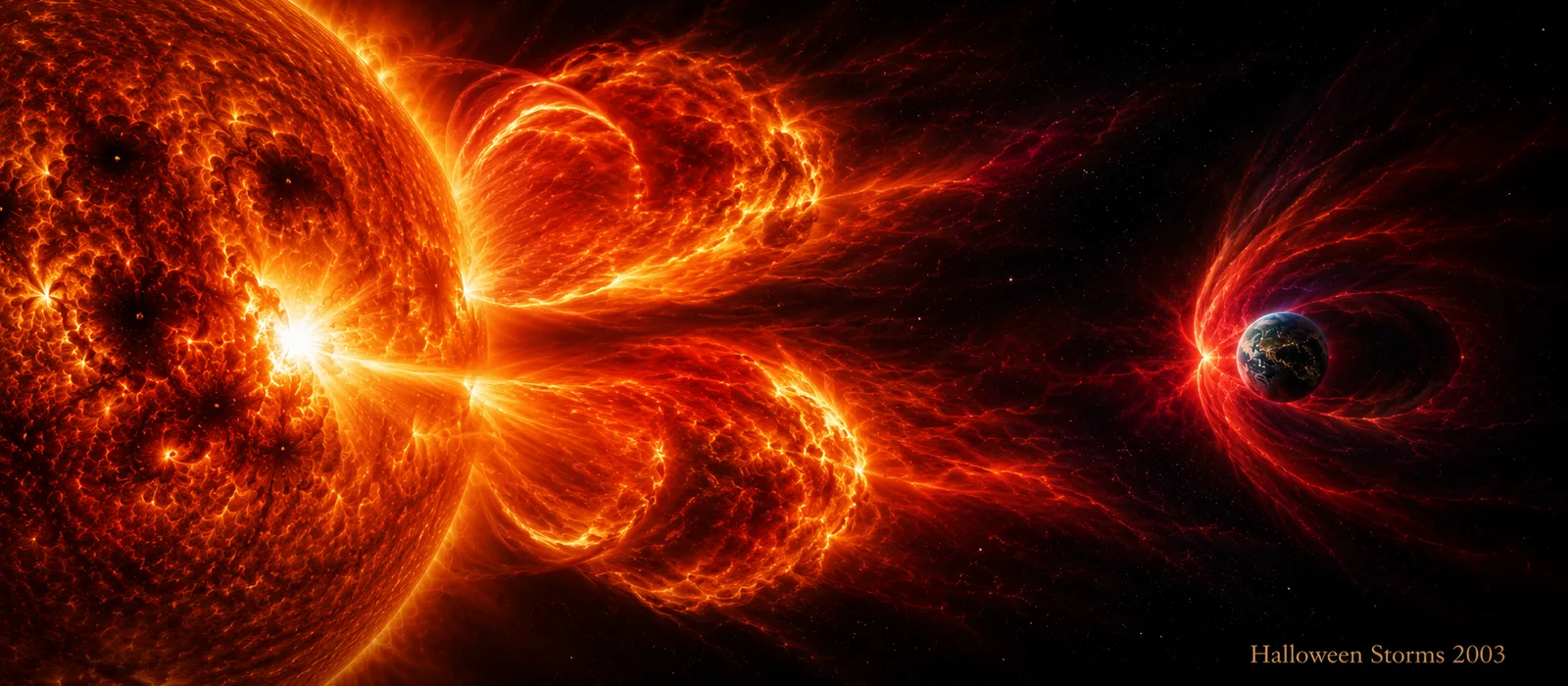
In late October 2003, a colossal active region, AR 486, dominated the Sun alongside two other large groups. On 28 October it produced an X17 flare and hurled a fast CME straight at Earth; it arrived the next day and drove an extreme G5 storm. Barely a day later another major eruption hit, and a second G5 storm followed on 30 October.
Then, on 4 November, as the region rotated toward the Sun's edge, it fired the largest flare ever recorded, saturating detectors at X17 and later estimated near X28–X45. Its X-rays hit Earth in full, blacking out HF radio on the sunlit side, but the CME it launched was aimed away from the Sun-Earth line, so the geomagnetic storm that followed was mild. A vivid lesson in how direction, not just size, decides a flare's effect.
2Timeline
- 28 Oct, ~11 UTCAR 486 produces an X17 flare and a fast halo CME aimed at Earth.
- 29 OctThe CME arrives; an extreme G5 storm begins. Aurora reaches the Mediterranean, Florida, and Texas.
- 30 OctA second fast CME drives back-to-back G5 conditions.
- 4 NovThe region, now near the limb, fires the most intense flare on record (~X28–X45). The flare hits Earth in full; its CME does not.
3The science
The Halloween Storms are a case study in compounding hazards: intense flares (radiation arriving in minutes), strong solar radiation storms (energetic protons), and fast Earth-directed CMEs (the geomagnetic storms a day later) all from the same hyperactive regions. The CMEs were fast enough, well over 2,000 km/s near the Sun, to cross to Earth in roughly a day, and they carried strongly southward fields that pushed Kp to 9.
4Impacts
- Power grid. A transformer-related failure caused a blackout of roughly half an hour for ~50,000 customers in Malmö, Sweden.
- Satellites. Numerous spacecraft were affected; the Japanese ADEOS-II (Midori-II) satellite was lost, and many craft entered safe mode.
- Aviation & humans. Polar airline routes were diverted to avoid radio blackout and radiation; astronauts aboard the ISS took shelter.
- Beyond Earth. A radiation instrument on NASA's Mars Odyssey was knocked out. Space weather is a Solar-System-wide phenomenon.
5By the numbers
6What if it happened today?
The Halloween Storms are a modern worst-case we actually lived through, with satellites, GPS, and grids already in play. They drove major investment in space-weather forecasting and grid resilience in the years that followed. A repeat today would test a far more satellite-dependent civilization, but also a far better-warned one.
7Watch it yourself
8Sources & further reading
- NOAA SWPC / NGDC: “Intense Space Weather Storms October 19 – November 07, 2003” (service assessment).
- NOAA NCEI: Remembering the Great Halloween Solar Storms
- Solar wind & Kp: CDAWeb OMNI / GFZ Potsdam (measured). CME geometry authored from event records.
Get the occasional update
A short email when there's a notable solar storm or a new CME Tracker feature. No spam, unsubscribe anytime.