1What happened
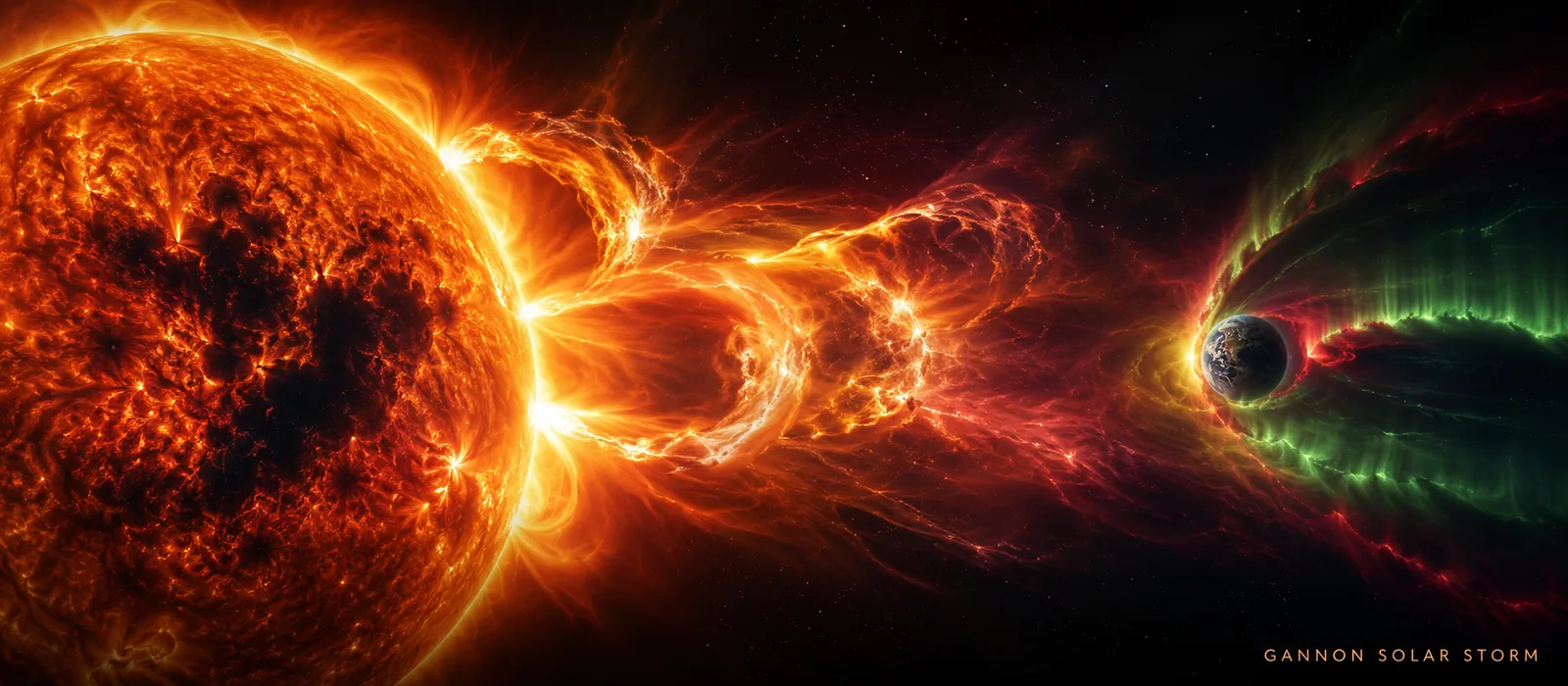
In early May 2024, an enormous sunspot complex, cataloged NOAA Active Region 3664, rotated across the face of the Sun. It was one of the largest sunspot groups in decades, sprawling roughly 200,000 km across (around 15 Earths side by side), big enough to be visible through eclipse glasses without a telescope.
Between 8 and 9 May the region erupted again and again, launching a series of fast, full-halo CMEs aimed squarely at Earth. Because they left the Sun in quick succession, the faster later clouds caught up with the earlier ones and merged into a single, denser disturbance on the way out, sometimes called a “cannibal” CME.
The combined shock reached Earth on 10 May 2024. As its magnetic field turned strongly southward, the key that unlocks Earth's magnetosphere, geomagnetic activity exploded to G5 (extreme), the top of NOAA's storm scale and the first G5 storm since the Halloween Storms of 2003. NOAA issued its first G4 watch in nearly 20 years, then escalated to a rare G5 warning.
2Timeline
- Early May 2024Giant region AR 3664 rotates into view and begins producing frequent M- and X-class flares.
- 8–9 MayA succession of fast, Earth-directed halo CMEs launches from the region.
- 10 May, ~17 UTCThe merged CME shock arrives at Earth; the storm ramps up quickly through G3 and G4.
- 10–11 May (peak)The interplanetary magnetic field turns strongly southward and Kp hits 9: G5, extreme. Aurora is reported at remarkably low latitudes worldwide.
- 11–12 MayConditions slowly settle as the disturbance passes and the field recovers.
- 14 MayNow near the Sun's western edge, AR 3664 fires an X8.7 flare, the largest of solar cycle 25 to that point, but most of its blast is no longer aimed at Earth.
3The science
A geomagnetic storm needs three things to line up, and May 2024 delivered all of them at once:
- A powerful source. AR 3664's size and magnetic complexity let it launch multiple fast CMEs in a short window.
- Earth-directed aim. The CMEs left the Sun as full halos, expanding straight along the Sun–Earth line, so Earth was inside the cone rather than off to the side.
- A strongly southward field. When the magnetic field embedded in the arriving cloud points south (negative Bz), it cancels against Earth's own northward field and lets solar-wind energy pour in. May 2024's Bz plunged to roughly −40 to −50 nT and stayed there.
The merging of several CMEs mattered too: a stacked, compressed cloud carries a stronger, longer-lasting southward field than any single eruption would, which is part of why the storm reached the very top of the scale.
4Impacts on Earth
- The most-photographed aurora in history. Northern (and southern) lights were seen far outside their usual range: across the southern United States, Mexico, the Caribbean, southern Europe, and South Africa. Thanks to smartphone cameras, they were shared by millions.
- Precision GPS disrupted. High-accuracy GNSS positioning degraded during the storm, notably halting some GPS-guided farm equipment in the middle of US planting season.
- Satellites felt the drag. The storm heated and puffed up the upper atmosphere, increasing drag on low-orbiting satellites; operators of large constellations reported measurable orbital effects.
- Radio and power. High-frequency radio experienced blackouts on the sunlit side, and grid operators managed voltage irregularities, but advance warning helped avert any major blackout.
- It rebuilt Earth's radiation belts. The storm's most surprising legacy was found months later: NASA's CIRBE CubeSat discovered the storm had created two new temporary radiation belts, sandwiched between the permanent Van Allen belts. The electron belt persisted for over three months, far beyond the ~four weeks typical of storm-made belts, and the second belt contained high-energy protons, something temporary belts almost never do, and outlasted it. New belts mean new radiation zones that satellite operators and crewed missions have to route around (Li et al., JGR Space Physics, Feb 2025).
5By the numbers
Open the replay for the exact CME speeds, arrival times, and the measured wind and Kp behind these figures.
6What if it happened today?
It essentially did, which is what makes the Gannon Storm such a useful benchmark. It showed that a modern, satellite-dependent world can take a G5 hit with disruption but not catastrophe when there's warning: forecasters flagged it days ahead, grid and satellite operators prepared, and the worst outcomes were avoided. It was also a reminder of how much we now rely on space-based positioning: a quiet GPS degradation rippled into agriculture, surveying, and timing systems far from any aurora.
7Watch it yourself
The replay loads the real catalog of CMEs from this storm plus the measured solar wind and Kp, and turns the whole tracker into a scrubbable time machine. Press play to watch the eruptions sweep out to Earth, select a CME to see its predicted arrival and storm strength, and check the Earth globe as the magnetosphere reacts.
8Sources & further reading
- NOAA Space Weather Prediction Center: Historical comparison of the May 2024 solar storms
- NASA: How NASA tracked the most intense solar storm in decades
- NASA: NASA CubeSat finds new radiation belts after May 2024 solar storm (CIRBE/REPTile-2; Li et al., JGR Space Physics, Feb 2025)
- CME & flare data: NASA DONKI. Solar wind: CDAWeb OMNI. Kp: GFZ Potsdam. (The figures here are observed; arrival math in the replay is a model. See accuracy.)
Get the occasional update
A short email when there's a notable solar storm or a new CME Tracker feature. No spam, unsubscribe anytime.