1What happened
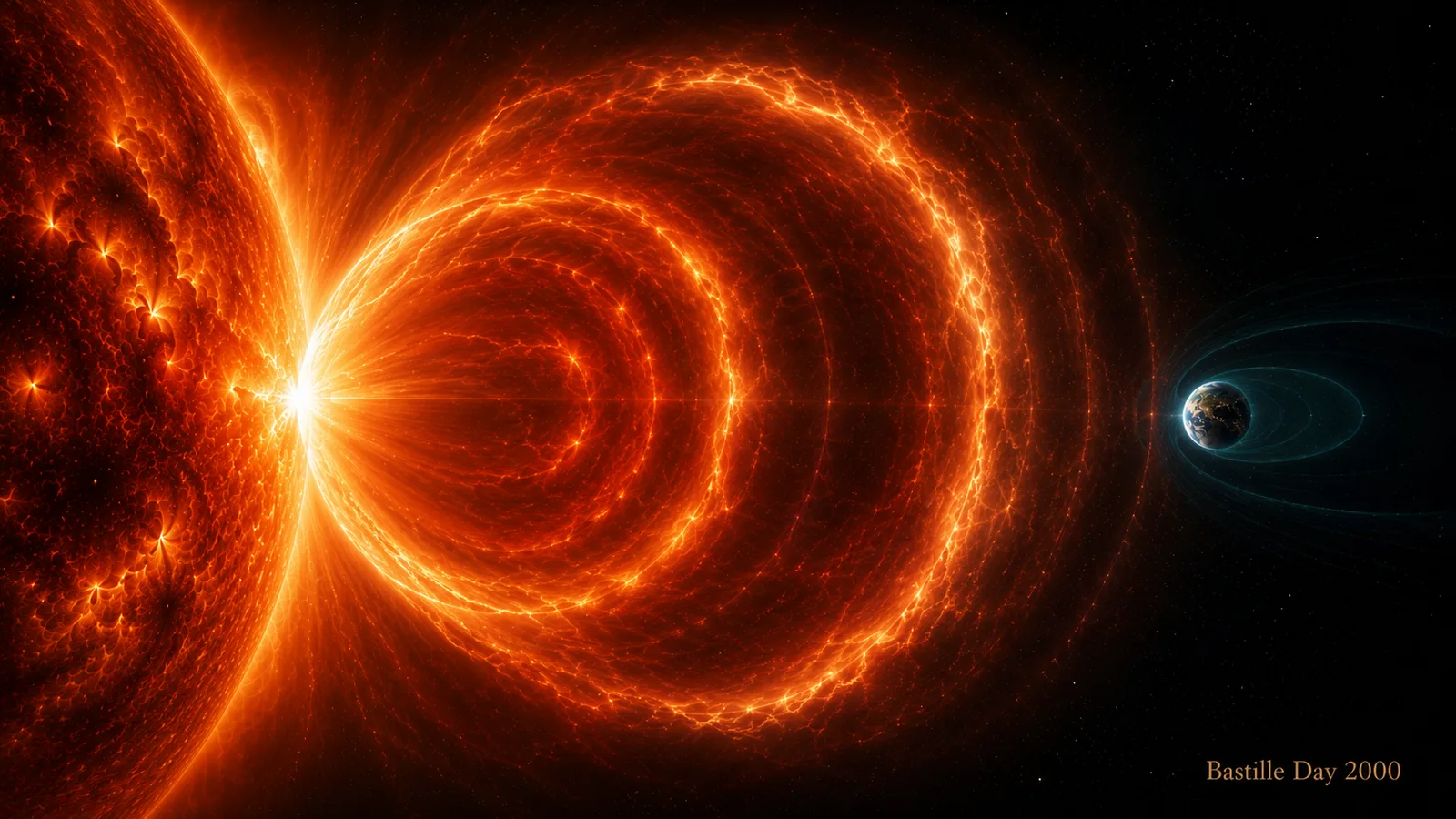
On 14 July 2000, active region AR 9077 produced an X5.7 flare and a fast, fully halo CME, the signature of an eruption coming almost straight at Earth. The flare also unleashed a strong solar radiation storm, with energetic protons reaching Earth quickly and even speckling the cameras on the SOHO spacecraft.
About 28 hours later, on 15 July, the CME arrived. The magnetic field it carried turned sharply southward, to around −61 nT, among the strongest ever measured. An extreme G5 storm followed, with Kp hitting 9 and aurora reported as far south as Texas.
2The science
Bastille Day is a clean example of the most geoeffective setup there is: a fast, fully Earth-directed halo CME carrying a strong, sustained southward field. There's no ambiguity about aim: a halo means the cloud is expanding toward you. The extreme negative Bz is what turned a fast CME into a top-of-scale storm.
It's also a reminder that flares and CMEs are a package deal: the same eruption produced a prompt radiation storm (arriving in minutes to hours) and the geomagnetic storm a day later.
3By the numbers
4Why it matters
Bastille Day 2000 became a benchmark event for the modern space-weather era, extensively studied because it was so well observed by the then-new fleet of solar spacecraft (SOHO, ACE). It's a reference point for what a clean, fast, Earth-directed halo CME does when its magnetic field cooperates.
5Watch it yourself
6Sources & further reading
- NOAA NESDIS: 25th Anniversary of the Bastille Day Solar Event
- Numerous studies in the AGU “Bastille Day” literature (e.g. Solar Physics & JGR, 2001).
- Solar wind & Kp: CDAWeb OMNI / GFZ Potsdam (measured). CME geometry authored from event records.
Get the occasional update
A short email when there's a notable solar storm or a new CME Tracker feature. No spam, unsubscribe anytime.